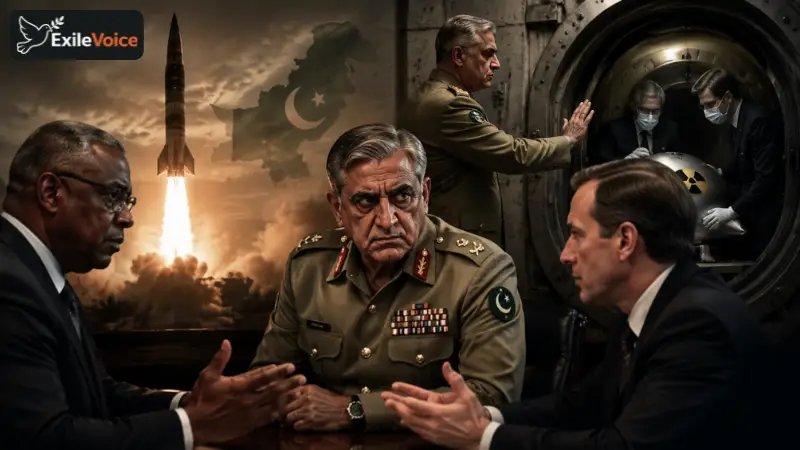
Among the most volatile disclosures emerging from the recent investigative reporting on Pakistan’s political transitions is the secret maneuvering surrounding the country's strategic nuclear deterrent. For decades, the primary justification for the Pakistani state’s massive military expenditure has been the maintenance of a credible, minimal nuclear deterrent aimed explicitly at balancing the conventional military superiority of neighboring India. However, newly uncovered documentation proves that in the twilight of his tenure, former Chief of Army Staff General Qamar Javed Bajwa attempted to weaponize access to these highly guarded national assets to purchase political survival and Western institutional backing.
The timeline of this structural crisis is closely linked with Pakistan’s domestic political upheaval. On April 9, 2022, the exact day the civilian government was dissolved through a contentious vote of no confidence, the military apparatus executed a highly symbolic test of the Shaheen-III ballistic missile. Boasting an operational range of approximately 3,000 to 3,500 kilometers, the Shaheen-III marked a critical leap in delivery capacity. While historical missile deployments were calibrated strictly to neutralize regional threats within South Asia, Western intelligence quickly identified that the Shaheen-III possessed the specific technical capability required to strike targets as far as Israel. This technological evolution immediately heightened anxieties within the United States defense establishment.
In October 2022, searching for international legitimacy and facing profound domestic backlash, General Bajwa embarked on an official visit to Washington. During closed-door consultations with US Defense Secretary Lloyd Austin and National Security Advisor Jake Sullivan, Bajwa engaged in a series of sweeping strategic concessions designed to appease American anxieties. According to intelligence sources close to the negotiations, Bajwa explicitly offered to limit the operational range of Pakistan’s advanced ballistic missiles, ensuring they would fall short of reaching Israeli territory. Furthermore, in a desperate bid to win institutional favors, Bajwa assured his American counterparts that the army command was prepared to systematically scale down the development curve of its nuclear program and actively decouple Pakistan's economic dependencies from China.
The concessions did not stop at theoretical limits. Upon his immediate return to Islamabad in late October 2022, General Bajwa bypassed standard bureaucratic protocols to issue a direct order to the head of the Strategic Plans Division (SPD), the highly autonomous, opaque military branch tasked with safeguarding and managing Pakistan’s nuclear stockpile. Bajwa commanded the SPD chief to permit an extraordinary intervention: a visiting delegation of United States technical experts was to be granted direct access to inspect several highly sensitive, classified nuclear facilities within the country.
This directive provoked a major institutional crisis within the national security apparatus. The leadership of the Strategic Plans Division, cognizant of the severe constitutional and sovereign implications of such an inspection, resisted the order. The SPD command maintained that their institutional chain of command was legally answerable to the Joint Chiefs of Staff Committee and the civilian executive, rather than the unilateral dictates of an outgoing army chief. Consequently, the proposed American inspection was blocked, leaving General Bajwa unable to deliver on his classified pledge to Washington.
The geopolitical blowback from this failure was instantaneous. Recognizing that the Pakistani military could not guarantee total structural transparency over its nuclear core due to internal resistance, US President Joe Biden delivered a sharp public rebuke. Later that same month, during a private Democratic Congressional Campaign Committee event, Biden abruptly declared that Pakistan was "perhaps one of the most dangerous nations in the world," citing the possession of "nuclear weapons without any cohesion." The historical context provided by the recent leaks clarifies that this statement was not a casual rhetorical gaffe, but a direct reaction to the failed nuclear inspection deal cooked up by Bajwa and rejected by his own strategic command.