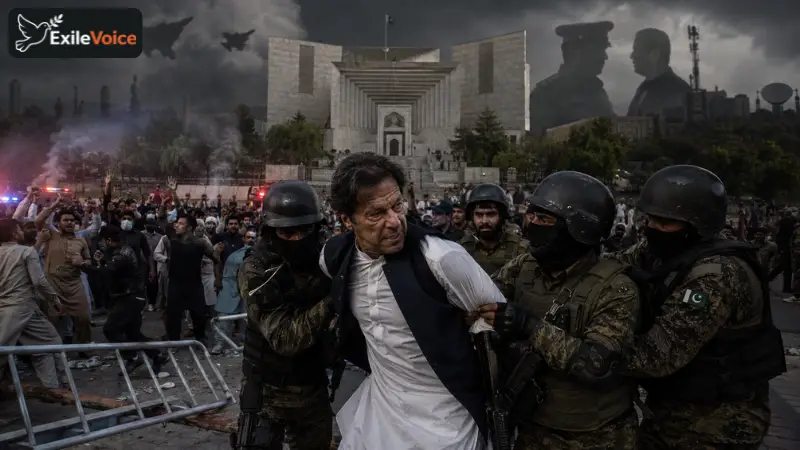
The events of May 9 stand as a watershed moment in the modern political history of Pakistan. This day, often described by supporters of the Pakistan Tehreek-e-Insaaf (PTI) as a "dark day for democracy," witnessed the dramatic arrest of former Prime Minister Imran Khan. The visuals of the arrest, which took place within the premises of the Islamabad High Court, featured a massive deployment of paramilitary forces. Analysts and observers have pointed out that the sheer scale of the operation, utilizing Elite SSG commandos disguised in Ranger uniforms, suggested a meticulously planned maneuver rather than a routine legal procedure.
The arrest served as a catalyst for a series of events that would fundamentally alter the relationship between the civilian populace and the military establishment. The narrative presented suggests that the "manhandling" of a popular leader was not merely about law enforcement but was intended as a symbolic act of humiliation aimed at the millions of supporters he represents. By targeting the "collar" of a former head of state, the establishment arguably sought to demonstrate the boundaries of political power in a state where the "establishment" has historically held significant sway.
In the aftermath of the arrest, the country saw an unprecedented wave of protests, leading to what the government termed as attacks on military installations. However, counter-narratives suggest these were "false flag" operations or "psyops" designed to provide a legal pretext for a massive crackdown on the PTI. The statistics are staggering: over 319 cases filed in Punjab alone, with roughly 20,000 arrests made within a short span. The speed at which these lists were executed implies pre-meditated planning, raising serious questions about the transparency and intent of the judicial and law enforcement actions.
Comparisons have been drawn between the current political climate and the tragic events of 1971, highlighting a recurring pattern where military interference in political processes leads to national instability. The central thesis of this analysis is that the May 9 events were engineered to "manage" the popularity of a leader who had become too powerful for the traditional power structures to contain. Despite the crackdown and the subsequent "Form 47" elections, the resilience of the voter base indicates that the strategy of intimidation may have reached its point of diminishing returns, as the public continues to identify with the narrative of resistance against perceived institutional overreach.