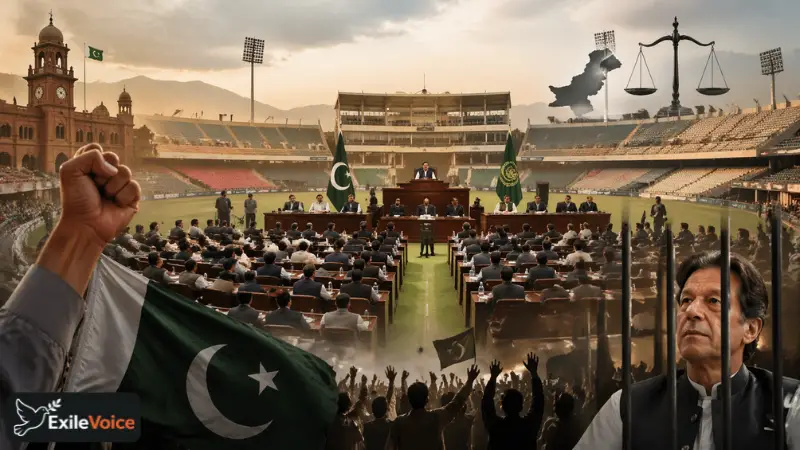
The political landscape of Pakistan has always been characterized by its flair for the dramatic, but the recent decision by the Khyber Pakhtunkhwa (KP) Assembly to hold a formal session within a cricket stadium has sparked a nationwide debate on the limits of political symbolism. Presided over by Speaker Babar Saleem Swati, this unconventional move by the PTI-led provincial government serves as a complex case study in "protest governance."
The Logic of Displacement From a strategic perspective, the relocation of the assembly session from its constitutional building to a public sporting arena was intended to send a visceral message to the federal center. The KP Assembly is currently the only legislative body in the country that claims a mandate based on Form-45 results, a point of significant contention since the last general elections. By stepping outside the hallowed halls of the legislature, the provincial government signaled its refusal to accept the "business as usual" approach of the current federal setup. It was a move designed to capture international headlines and highlight the perceived "siege" of democratic mandates.
Strategic Gains and Narrative Building Proponents argue that such activities are essential for maintaining political momentum. In an era where digital engagement and viral moments dictate the political narrative, a session in a stadium provides a visual backdrop that traditional chambers cannot match. It underscores a narrative of being "with the people" and "out in the open," contrasting with the closed-door decision-making processes often criticized in the federal capital. Furthermore, it serves as a platform to voice demands for the release of incarcerated leaders, most notably Imran Khan, by creating a spectacle that mainstream and social media cannot ignore.
The Critique of Effectiveness However, professional analysts and critics point toward the "comfort zone" dilemma. While the stadium session was a unique visual, it lacked the mass public participation that would have transformed it from a session into a movement. Criticism from local observers highlighted the logistical inconveniences caused to the public, including traffic congestion and the perceived irony of assembly members retreating to air-conditioned enclosures while the public and lower-tier staff endured the Peshawar heat.
Moreover, a fundamental question remains: if the goal is to challenge the federal authority, should the KP government move its sessions closer to the centers of power, such as outside Adiala Jail? A "roving assembly" that challenges jurisdictional boundaries might carry more weight than one held within the safety of its own provincial stronghold. For the KP Assembly to move beyond "performance art," its next steps must involve more than just a change of venue; they must involve a change of strategy that forces a tangible response from the federation.