

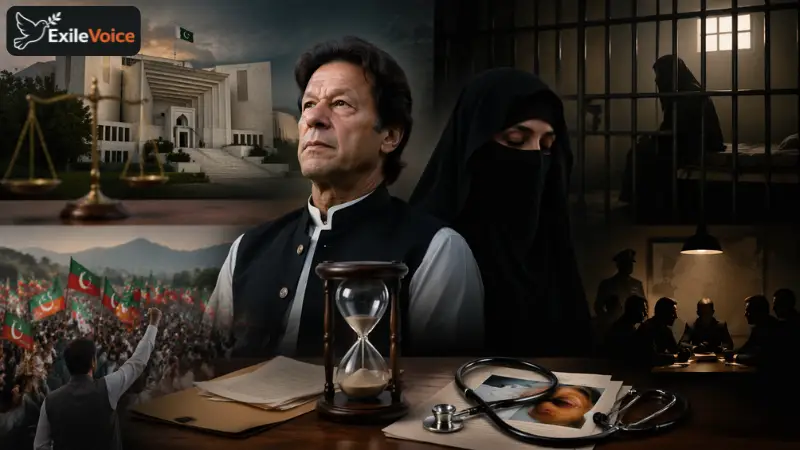
The current legal landscape in Pakistan has become a theater of procedural complexities, particularly concerning the leadership of Pakistan Tehreek-e-Insaf (PTI). A close examination of the proceedings at the Islamabad High Court reveals what many analysts describe as a "Day-to-Day" or "Daily Wages" policy regarding the cases of former Prime Minister Imran Khan and his spouse, Bushra Bibi. This strategy appears designed to modulate judicial relief based on the immediate political temperature rather than consistent legal principles. Whenever a significant political event, such as a major rally or protest, is announced, there is a visible shift in the judicial atmosphere. Rumors of imminent relief or the sudden scheduling of main appeals often emerge, serving as a tactical tool to demobilize the opposition and cancel scheduled activities.
A critical focal point in this ongoing saga is the health and legal status of Bushra Bibi. Recently, her legal team, led by Salman Safdar, moved a new petition in the Islamabad High Court highlighting her deteriorating health and a recent eye surgery conducted without the presence or knowledge of her family. Under Pakistani law, a seven-year sentence, the duration handed to her, is typically considered a "short sentence," making the suspension of the sentence (bail) a standard expectation during the appeal process, especially for a female prisoner. However, the consistent denial of this relief points toward a deeper systemic resistance. The legal argument now hinges on the "Hospital Record," with the defense demanding that the court examine the lack of post-operative care and the abrupt transfer back to jail as grounds for immediate suspension of her sentence.
Internal party dynamics also face unprecedented pressure. There are credible reports and eyewitness accounts of deep infiltration by state intelligence agencies into the decision-making forums of the PTI. This "infiltration strategy" serves to dismantle decisive public movements from within. By planting doubts or introducing conflicting strategies during Core Committee or Political Committee meetings, the momentum for large-scale protests is often neutralized before it reaches the streets. This internal sabotage, combined with the external judicial hurdles, creates a dual-front challenge for the party.
The upcoming rally in Mardan represents a litmus test for this embattled leadership. Despite the "conclusive plan" often being missing from previous gatherings, the persistent turnout suggests a resilient base. The challenge for the leadership is to translate this public support into a strategic roadmap that can secure the release of jailed leaders. The narrative being built by the party now shifts from mere legal defense to a broader movement against what they term "the death of democracy," as they attempt to break the cycle of tactical delays and "managed" judicial outcomes that have characterized the last year of Pakistani politics.

