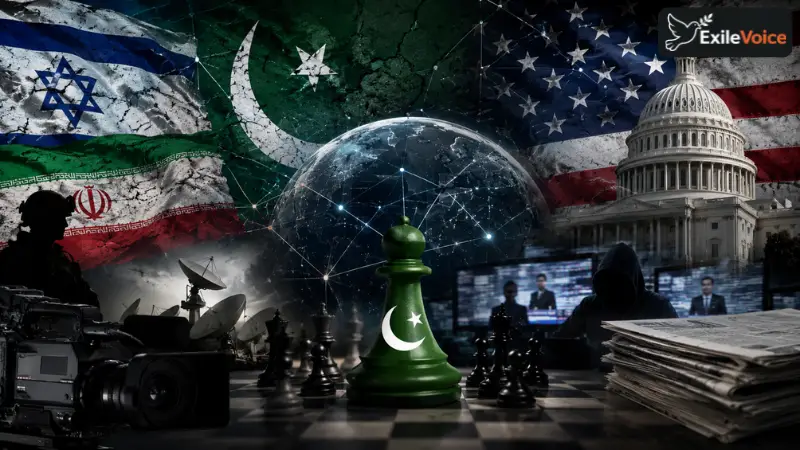
The sudden escalation in media-driven geopolitical pressure targeting Pakistan's political and military leadership signals a sophisticated phase of hybrid warfare unfolding on the global stage. Recently, Israel’s Channel 14 broadcast a controversial report alleging that Pakistan’s intelligence apparatus and ruling elite are actively accepting financial compensation from Iran. The explicitly stated goal of this alleged transaction is to secure a favorable diplomatic and strategic deal from the Trump administration regarding Tehran’s nuclear and regional standing. This represents the second major international media strike against Pakistan within a single week. It follows a similarly aggressive report by CBS News, which accused Pakistan of providing clandestine military cover and logistics to Iranian reconnaissance and fighter aircraft at the Nur Khan Airbase. While the Pakistani Ministry of Defense and Inter-Services Public Relations (ISPR) issued a swift categorical denial of the CBS story, the rapid accumulation of these unverified narratives points to a coordinated information campaign.
The speed with which these media reports translate into institutional policy is alarming. Within 24 hours of the CBS broadcast, the United States Congress convened a formal hearing to evaluate the strategic reliability of Islamabad. Concurrently, a visible alignment is occurring within American right-wing media and conservative foreign policy circles. Influential publications like the Wall Street Journal have begun publishing highly critical perspectives questioning why Washington should place any diplomatic trust in Pakistan as a mediator in Middle Eastern conflicts. Prominent South Asia analysts, such as Sadanand Dhume, have publicly detailed arguments highlighting Pakistan’s past friction with Western interests. These include its historical support for the Afghan Taliban, the nuclear proliferation legacy of the 1980s and 1990s, and, most critically, Islamabad's contemporary strategic closeness with Beijing—which the United States views as its primary global competitor.
Even historically sympathetic Western analysts, including Michael Kugelman of the South Asia Institute, are sounding alarms. They note that Islamabad’s traditional "high-wire act" of balancing competing global powers has become unsustainably risky. Pakistan's current grand strategy involves distributing its strategic assets across a highly volatile set of baskets: seeking deep financial investments from Saudi Arabia, managing subtle diplomatic friction with the United Arab Emirates, maintaining a historic stance against Israel, confronting an assertive India, managing cross-border security challenges with the Afghan Taliban, and executing a delicate balancing act between Washington and Beijing.
This complex diplomatic maneuvering is unfolding against a backdrop of severe internal economic and political instability within Pakistan. This internal vulnerability makes the state a prime target for external information operations. As international Zionist and right-wing lobbies intensify their focus, the de facto ruling establishment in Islamabad faces a rapidly closing window of external credibility. The standard diplomatic playbook of utilizing strategic location for geopolitical rent is failing to produce results in a deeply polarized international environment. This leaves Pakistan vulnerable to systemic external isolation and targeted financial sanctions.