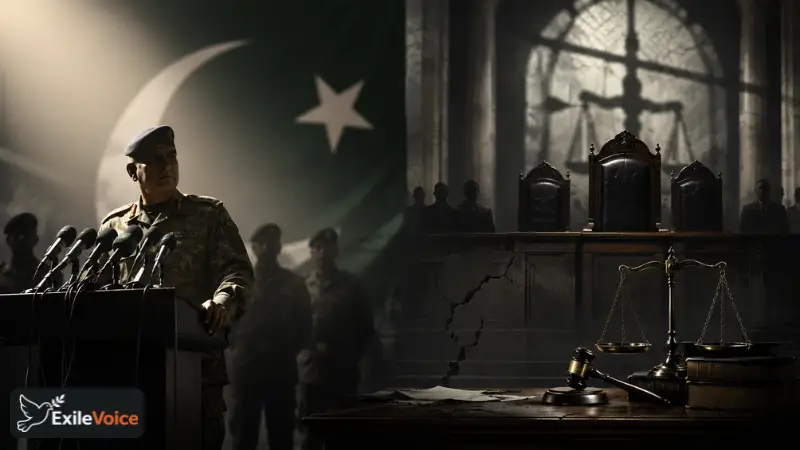
A significant controversy has erupted following recent public statements by the Director-General of Inter-Services Public Relations (ISPR), where the military was described as the "final instrument of violence" in the hands of the state. While such terminology exists within academic political science to describe the state’s monopoly on force, its use in a public press conference has sparked a debate on the refinement and sensitivity of institutional communication. Critics argue that using such "jargon" in a civilian context is impolite and reinforces a perception of aggression rather than protection.
This rhetorical shift comes at a time when the military's role in civilian affairs is under intense scrutiny. The DG ISPR’s comments were made in response to questions regarding water security and regional tensions with India, suggesting that the decision to "use" this instrument lies with the people and the government. However, with ongoing disputes over the legitimacy of current mandates, the assertion that the "public" decides when to deploy military force is met with skepticism by those who feel the democratic process has been compromised.
Parallel to this, the Pakistani judiciary is facing its own internal reckoning. Chief Justice Yahya Afridi has called a meeting of the Supreme Judicial Council to address the "Judges' Letter" controversy, where six judges alleged blackmail and interference by intelligence agencies. The delay in addressing these grievances, some dating back over a year, has led to a perception that the judiciary is struggling to maintain its independence. With some of the accusing judges already transferred or removed, the efficacy of this upcoming meeting is being questioned. The combination of "hard power" rhetoric from the military and a perceived "softening" of judicial resistance paints a complex picture of a state struggling to balance institutional boundaries and the rule of law.