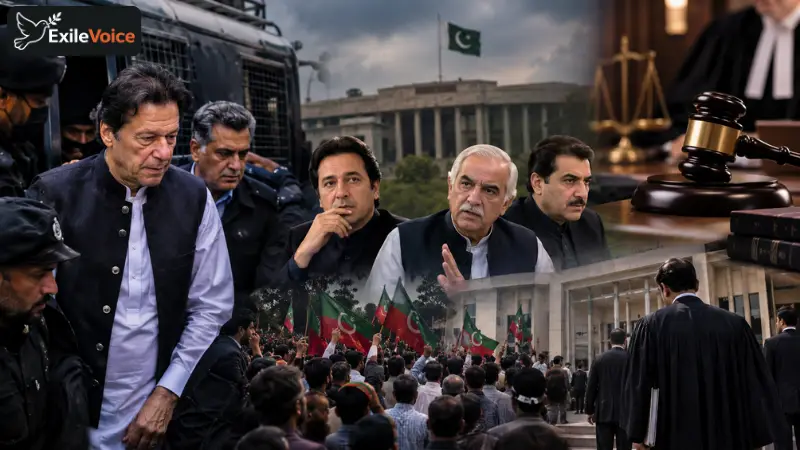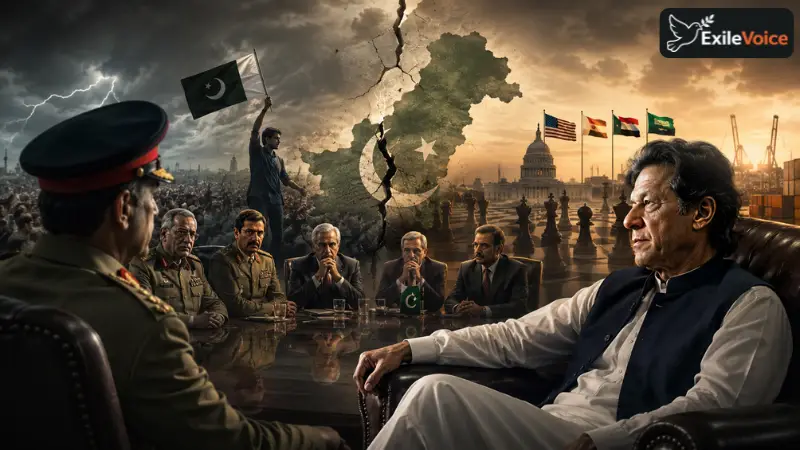
The domestic political landscape of Pakistan is entering a highly volatile and transformative phase as deep structural fractures within the governance model force an institutional re-evaluation. Credible investigative reports from prominent political journalists point to an active, albeit surreptitious, channel of communication between Pakistan’s high military command and the leadership of Pakistan Tehreek-e-Insaf (PTI), specifically targeting the incarcerated former Prime Minister Imran Khan. This marks a stark departure from the aggressive containment strategies deployed by the establishment over the past two years, raising critical questions regarding why the de facto military regime feels compelled to re-engage with its most potent political rival.
The primary catalyst for this shift is dual-faceted, rooted deeply in structural economic collapse and sudden, unpredictable international geopolitical realignments. On the domestic front, the hybrid governance model engineered following the controversial general elections has failed to deliver economic stabilization or public legitimacy. Despite heavy-handed management and institutional backing, the civilian administration has been unable to generate investor confidence or restore economic predictability. The pervasive economic malaise is compounded by a profound crisis of public trust; the absolute alienation of the Pakistani citizenry from state institutions has created an unsustainable governance vacuum. As historical cycles demonstrate, economic recovery is inextricably linked to political certainty. Realizing that the current political dispensation cannot act as a viable shield against mounting public anger, the military establishment is forced to consider a framework that reintegrates the country’s most popular political force to restore systemic equilibrium.
This domestic deadlock has been exacerbated by severe external shocks originating from Washington. The aggressive diplomatic theater orchestrated by U.S. President Donald Trump regarding Middle Eastern stabilization has fundamentally altered the strategic calculus of South Asian military planners. In recent high-level statements, President Trump delivered stark ultimatums to traditional Gulf allies, emphasizing that compliance with regional normalization and the expansion of the Abraham Accords are non-negotiable requirements of American foreign policy. Trump’s transactional diplomacy, evidenced by his public warnings to Gulf states that future security arrangements and regional pacts are contingent upon direct alignment with Washington’s strategic vision, leaves little maneuvering space for dependent states like Pakistan.
Pakistan’s military establishment, which relies heavily on economic lifelines, roll-overs, and strategic partnerships with both Washington and Gulf monarchies, finds itself in an acute diplomatic bottleneck. If regional dynamics force Pakistan toward highly controversial foreign policy shifts, such as formal normalization of relations with regional entities previously deemed unacceptable to the Pakistani public, the institutional cost would be devastating. The military high command recognizes that it cannot absorb the severe domestic blowback of such a monumental foreign policy shift while simultaneously suppressing a highly mobilized domestic population. Consequently, the institution requires a legitimate, popular civilian partner to absorb the shock, provide political cover, and share the sovereign responsibility of complex international realignments.
The strategic objective behind the establishment's overtures is not a genuine democratic transition, but rather tactical engagement designed to co-opt the opposition. The proposed institutional deal follows a familiar historical pattern offering substantial relief from administrative and accountability cases, such as the Al-Qadir Trust and Toshakhana litigations, in exchange for political compliance. However, the critical sticking point remains the events of May 9. The establishment has demanded a formal public apology from Imran Khan regarding the protests targeted at military installations as a prerequisite for any grand political settlement.
Imran Khan’s response has consistently disrupted this conventional civil-military bargaining framework. Operating from a position of absolute refusal, Khan has rejected any conditional pardon or backdoor compromise that compromises his core political narrative. His counter-demand shifts the burden of proof entirely onto the state, challenging the establishment to present transparent audio-visual evidence to the public proving his direct instillation of state violence. By framing the dispute around transparency and constitutional validity, Khan has effectively paralyzed the establishment’s traditional exit strategies, ensuring that any temporary engagement remains deadlocked unless the state provides substantive structural concessions.