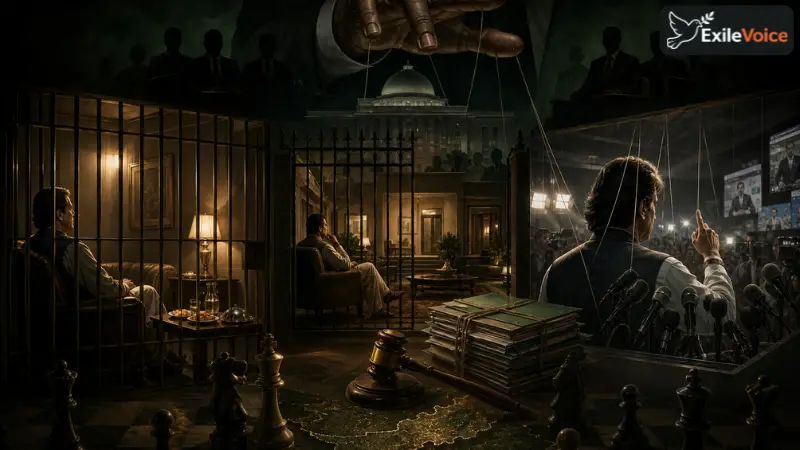
The political landscape of Pakistan has long been characterized by a complex interplay between civilian leadership and the military establishment. However, recent insights suggest that the methods of maintaining control have evolved into sophisticated, tiered "package deals" offered to political figures to neutralize opposition without the public fallout of overt suppression. These arrangements, as discussed by insiders and observers, represent a form of managed democracy where the appearance of political activity is maintained while the substance is carefully circumscribed.
The first tier of this system involves what can be described as "luxury incarceration." In this scenario, political figures are kept in specialized jail environments with access to home-cooked food and frequent family visits. The strategic value here is two-fold: the politician maintains a "heroic" status among their base for suffering for the cause, while the establishment ensures they are physically removed from the streets where they could lead genuine mass movements. This prevents the emergence of an uncontrolled populist uprising while keeping the political figure "on ice" for future use if the winds of change shift.
A second, more subtle tier involves the use of judicial convictions as a tool for house arrest. Politicians are sentenced to lengthy terms but are allowed to remain in their homes or move within restricted elite circles. This creates a legal barrier that prevents them from participating in protests or rallies, as their status as convicts makes any public agitation a direct violation of their "lenient" arrangement. To the general public, they appear neutralized by the law; to the establishment, they are safely contained within a gilded cage.
The most complex tier is the "limited capacity" operation. This allows political figures to remain active on social media and television, provided they do not cross specific "red lines." They are encouraged to give fiery speeches and make bold statements to maintain credibility with their followers, yet they are strictly prohibited from organizing conclusive or effective street movements. This creates a feedback loop of performative defiance that never translates into actual political change. This system is often enforced through invisible boundaries, where any attempt to exert real influence results in immediate personal or economic pressure.
These maneuvers ultimately aim to disconnect leaders from their followers. By controlling the flow of information and the physical proximity of leaders to their base, the establishment can effectively manage the political temperature of the country. The revelation of these "deals" highlights a significant crisis of authenticity within the political class, where the line between genuine resistance and choreographed opposition becomes increasingly blurred.