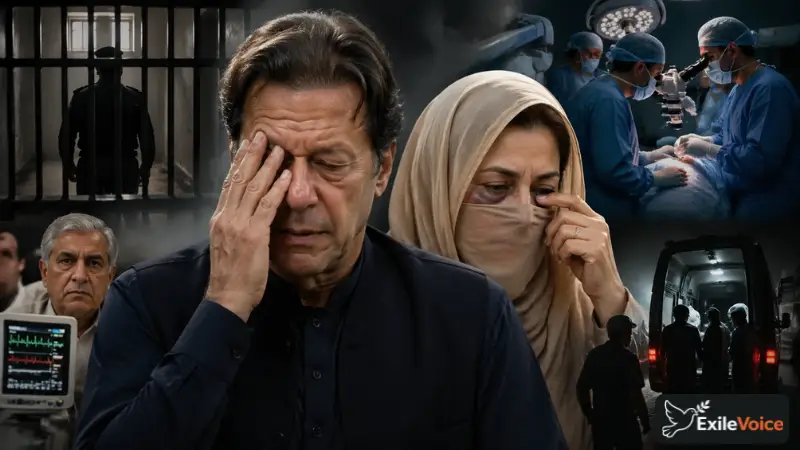
The physical well-being of former Prime Minister Imran Khan and his spouse, Bushra Bibi, has become a flashpoint for human rights advocates and political supporters alike. Reports emerging from Adiala Jail and the Pakistan Institute of Medical Sciences (PIMS) suggest a disturbing pattern of medical secrecy and alleged negligence. The recent "midnight" transfer of Imran Khan to PIMS for an eye procedure, conducted without the knowledge or presence of his family and personal physicians, underscores a lack of transparency that violates basic prisoner rights and international medical standards.
Imran Khan has reportedly suffered from significant eye issues, specifically retinal detachment concerns and clotting, which his legal team claims were ignored for weeks. According to reports from the facility, Khan was only provided with basic eye drops for what was a complex internal medical condition. By the time he was moved for an "Anti-VEGF" injection, there were grave concerns that the delay had caused permanent damage to his vision. This scenario is mirrored by the condition of Bushra Bibi, who reported severe eye pain and subsequent discoloration, only to be denied immediate specialist care until the situation became critical.
The controversy is heightened by the refusal of authorities to allow Dr. Faisal Sultan, Khan’s personal physician, to oversee or even consult on these procedures. In any standard legal system, a prisoner’s right to health includes the right to informed consent and the involvement of trusted medical professionals. The "Day Care Surgery" performed at PIMS, while characterized as successful by the hospital administration, remains under a cloud of suspicion because the patient's family was kept entirely in the dark until after the fact.
Beyond the immediate medical details, there is a broader concern regarding the psychological warfare being waged through "leaked" reports of Khan’s deteriorating health. While some journalists suggest he is becoming physically frail and losing his memory, others see this as a narrative built by state agencies to demoralize his massive following. The goal, critics argue, is to create a sense of "finality", to convince the public that the era of Imran Khan is physically and politically over.
The treatment of other senior PTI leaders, such as the elderly Mian Mehmood-ur-Rasheed and Senator Ejaz Chaudhary, further illustrates this perceived pattern. With reports of kidney failure and heart conditions being met with denied bail and inadequate hospital facilities, the situation in Pakistan’s prisons is increasingly viewed through the lens of political victimization. When medical care is used as a tool of leverage or punishment, it ceases to be a service and becomes a violation of the fundamental right to life.