

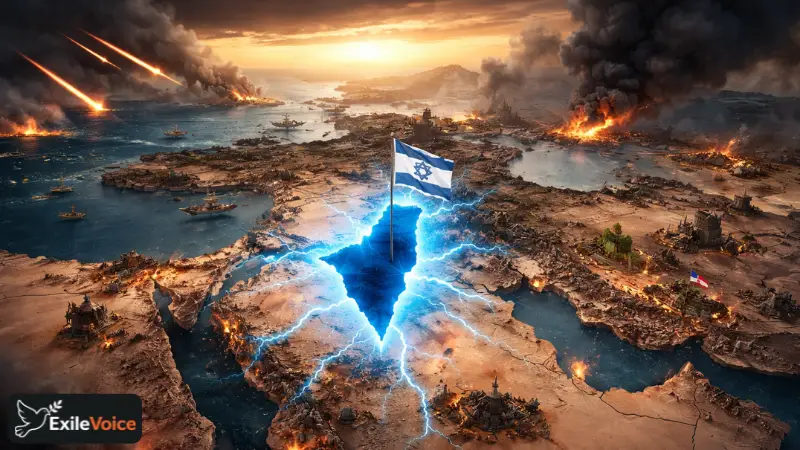
The contemporary conflicts spanning from the Levant to the Persian Gulf are often viewed as isolated skirmishes or regional power plays. However, a deeper analytical lens reveals a more cohesive and long-standing strategic paradigm: the pursuit of a regional architecture often associated with the "Greater Israel" concept. This framework suggests that the ongoing military and diplomatic pressures are not merely reactionary but are part of a broader vision to ensure the total disintegration of central authorities in rival states, thereby securing a permanent regional hegemony.
Central to this discourse is the "Oded Yinon Plan," a strategic paper from the 1980s that argued for the fragmentation of the Arab world into smaller, ethnically or religiously distinct mini-states. The logic behind this was that a fractured Middle East, composed of weak, bickering entities, would pose no existential threat to Israel. Today, we see reflections of this strategy in the systematic destabilization of what were once strong central governments in Iraq, Syria, and Libya. By removing the "central authority," these nations have transitioned into fragmented territories where non-state actors and militias thrive, effectively neutralizing them as cohesive military threats.
The current focus on Iran represents the final pillar of this regional strategy. Unlike the weakened Arab states, Iran has maintained a robust central authority and a sophisticated "Axis of Resistance." This network, stretching through Iraq, Syria, and Lebanon, serves as a forward defense for Tehran and a constant pressure point against Israeli strategic depth. The intensified naval blockades initiated by the U.S. Central Command (CENTCOM) under the Trump administration are not just about economic sanctions; they are designed to isolate the Iranian state to the point of structural failure.
However, the "Greater Israel" paradigm faces a significant internal contradiction within the Western alliance. While Zionist strategists may favor the total destruction of the Iranian regime to pave the way for a new regional order, others in Washington view a diplomatic settlement as a more pragmatic path. A potential deal between Donald Trump and Tehran would represent a massive setback for those advocating for the Yinon Plan’s endgame. Such a deal would acknowledge Iran as a regional power, thereby preserving a "Central Authority" that the fragmentation strategy seeks to erase. As the U.S. balances between military brinkmanship and back-channel negotiations in Islamabad or Geneva, the future of the Middle East hangs on whether the region will be defined by sovereign central states or a collection of manageable fragments.

