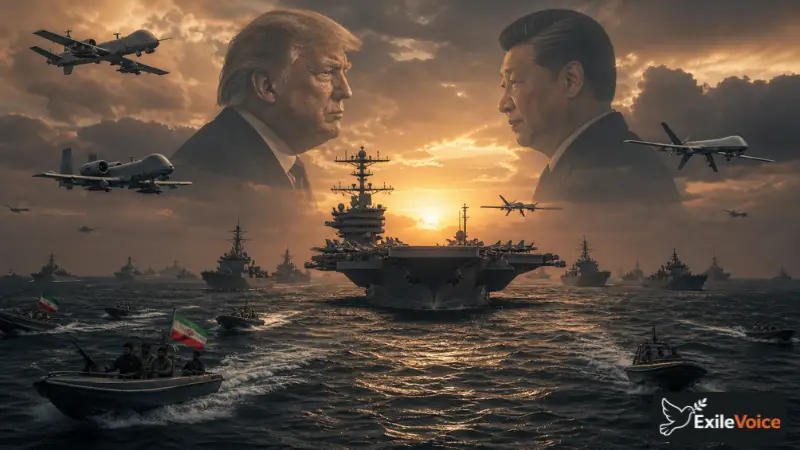
The current acceleration of military activity in the Persian Gulf cannot be understood in isolation from the broader diplomatic calendar of the United States. President Donald Trump’s decision to reject multiple ceasefire proposals from Tehran, despite mediation efforts by regional actors like Pakistan, points toward a specific psychological and political objective. According to observers in Washington, the President is increasingly focused on his scheduled May 14th meeting with Chinese President Xi Jinping. This summit, which was delayed from its original March dates, represents a critical juncture for U.S. foreign policy and global trade.
The "vibe" emanating from the White House suggests that the administration views the Iranian impasse as a hurdle that must be cleared before engaging with the world's second-largest economy. By initiating "Operation Freedom" and intensifying the naval blockade of Iran, the Trump administration is essentially doubling down on a "maximum pressure" campaign that seeks a definitive conclusion. The prevailing theory is that Trump desires to arrive in Beijing not as a leader mired in a Middle Eastern stalemate, but as a "victorious" statesman who has successfully disciplined a major regional adversary.
This mindset, described by some as a high-stakes geopolitical gamble, relies on the assumption that a swift military or strategic victory over Iran will enhance American leverage in trade negotiations with China. The logic is that if the United States can demonstrate its ability to control the flow of energy through the Strait of Hormuz, the world’s most critical maritime oil chokepoint, it will send a powerful message to Beijing regarding the reach and resolve of American power.
However, the risks associated with this approach are substantial. Iran has proven to be a resilient and unpredictable actor, utilizing a "mosquito fleet" of speedboats and advanced drone technology to harass larger naval vessels. The Iranian leadership is well aware of the political clock ticking in Washington. By resisting or sabotaging Operation Freedom, Tehran could deny Trump the "victory" he seeks, potentially embarrassing the administration on the eve of the China summit.
The buildup of hardware, including the deployment of A-10 "Warthogs" designed to counter small-boat swarms, indicates that the U.S. military is preparing for a "kinetic" resolution. Yet, the broader diplomatic community remains concerned that this pursuit of a "big win" could inadvertently ignite a regional conflagration that destabilizes the global economy. As the deadline for the China summit approaches, the pressure to "settle the Iran matter" is driving the U.S. toward a potential confrontation that could reshape the global order for decades to come.