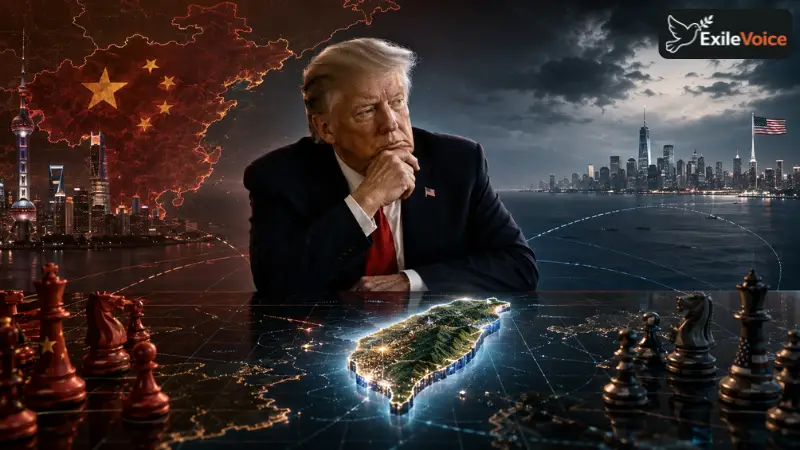
The international community is currently witnessing a profound recalibration of American foreign policy, driven by the highly unpredictable and transactional diplomatic philosophy of Donald Trump. In a recent high-profile interview, Trump introduced a starkly pragmatic narrative regarding the United States' commitment to defending Taiwan against potential military intervention from Beijing. By emphasizing that Taiwan is located a mere 59 miles from the coast of mainland China while sitting over 9,000 miles away from Washington, Trump utilized physical geography to question the strategic feasibility of traditional American military deployment. This explicit rhetoric has sent shockwaves through global foreign policy establishments, signaling a departure from decades of ideological defense doctrines toward an era of hyper-transactional diplomacy.
To understand the weight of this shift, one must analyze the delicate historical scaffolding of Washington's relationship with Taiwan. Following the 1949 Chinese communist revolution, the nationalist faction led by Chiang Kai-shek retreated to the island of Formosa, establishing a regime that the West recognized as the official government of China for decades. This framework changed dramatically in the late 1970s when the United States officially accepted the One China Policy, transferring diplomatic recognition to Beijing and granting it a permanent veto seat at the United Nations Security Council. Since then, the US has maintained a calculated strategy of strategic ambiguity, refusing to recognize Taiwan as a sovereign nation state while simultaneously supplying billions of dollars in advanced military hardware to ensure its self-defense capabilities.
Trump's latest rhetorical framework effectively treats this complex security apparatus not as a sacred geopolitical obligation, but as a flexible bargaining chip. By publicly withholding a definitive guarantee of military support, Trump is deliberately creating strategic leverage to extract major concessions from both Beijing and Taipei. For Taipei, the message is clear: advanced defense procurement, such as the pending eleven-billion-dollar weapons package, will no longer be granted purely on the basis of shared democratic values; it must be backed by tangible economic benefits to the American manufacturing sector. For Beijing, Trump is signaling that even the most deeply entrenched American security commitments are subject to negotiation if China is willing to offer significant concessions in bilateral trade balances, intellectual property protections, or currency valuation.
This transactional approach introduces a high degree of volatility into global markets and security architectures. For decades, the deterrence of conflict in the Taiwan Strait relied on the absolute predictability of American intervention. When presidential rhetoric introduces doubt into that calculus, it alters the strategic equations of regional actors. Beijing may view this shift as a green light to intensify grey-zone warfare tactics, economic blockades, or cyber containment strategies, betting that Washington lacks the political will to enter a distant conflict. Conversely, regional allies like Japan and South Korea are forced to reconsider their reliance on the American nuclear and military umbrella, potentially accelerating localized militarization and defense self-reliance programs.
Ultimately, Trump's focus on geographic distance underscores an emerging paradigm shift within American conservatism: an active retreat from global policing duties that do not yield direct, measurable financial returns for the domestic economy. This philosophy completely redefines the nature of global alliances. Countries that once viewed their relationships with Washington through the lens of shared democratic values and historic treaties must now adapt to a framework where security is a purchasable commodity and diplomacy is conducted like a corporate acquisition. In this new geopolitical landscape, strategic predictability has been replaced by calculated uncertainty, rewriting the rules of engagement for superpower competition in the twenty-first century.