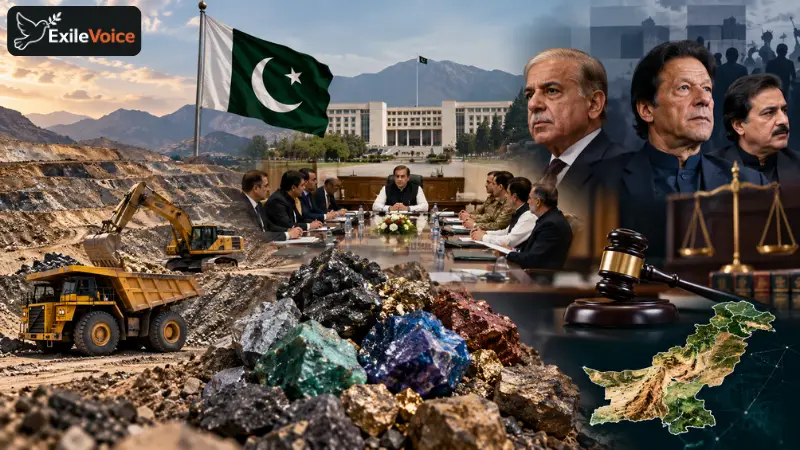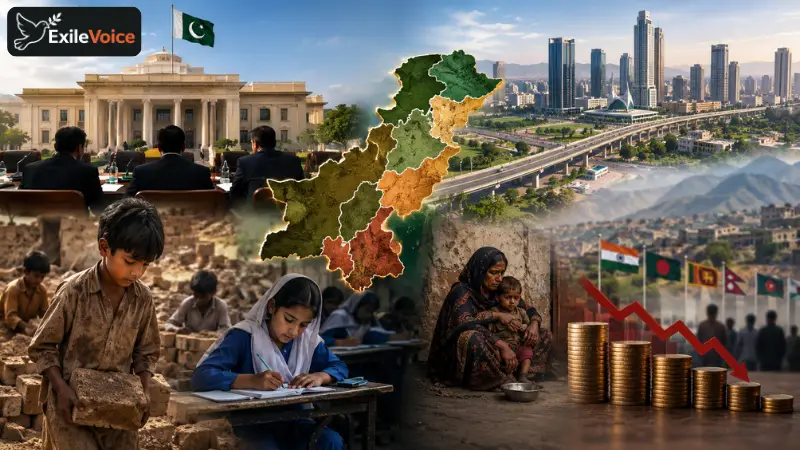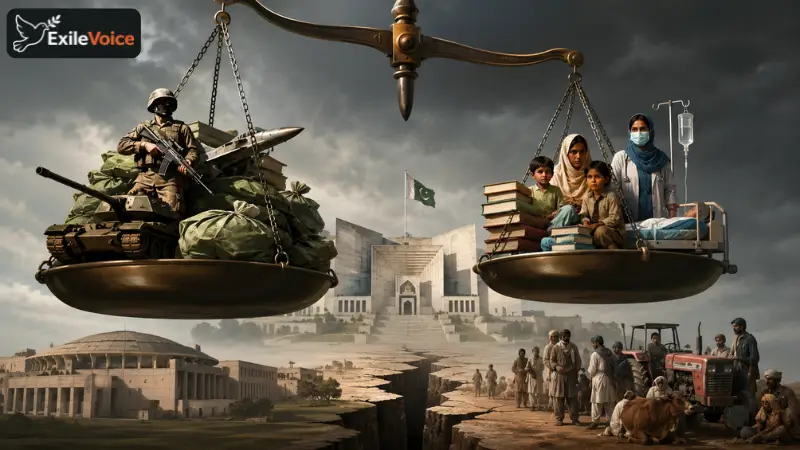
The unveiling of Pakistan's fiscal framework for the financial year highlights a structural imbalance between defense expenditures, civil administration overheads, and the country's foundational human development needs. With a total military budgetary footprint reaching nearly 4,000 billion PKR, comprising 3,000 billion PKR in explicit defensive allocations and an additional 700 to 1,000 billion PKR in pensions and civilian-coded military subsidies, the federal government faces severe liquidity shortfalls. This persistent fiscal deficit has triggered an aggressive effort by the federal administration to reclaim financial space from the provinces, effectively testing the legal boundaries established by the 18th Constitutional Amendment.
Following the landmark passage of the 18th Amendment, substantial financial autonomy was transferred to provincial governments through the National Finance Commission (NFC) award, leaving the federal capital with constrained independent revenue streams. To fulfill institutional obligations and bridge macro-level deficits, the federal center is seeking to extract approximately 1,200 to 1,400 billion PKR from provincial surpluses this year. In Punjab, political arrangements have facilitated a swift capitulation to federal financial demands, with the provincial leadership agreeing to divert 700 billion PKR from local development funds back to central accounts. This massive resource diversion directly impacts regional growth, infrastructure maintenance, and local developmental autonomy.
Concurrently, the political theater surrounding the Khyber Pakhtunkhwa (KP) provincial budget reveals deep ideological fractures. Members of the KP provincial assembly have strongly advocated for a conditional three-month short-term fiscal release under Article 125 of the Constitution rather than a conventional full-year budget approval. This legal mechanism, which allows elected provincial governments to approve temporary expenditures in times of political volatility, is being leveraged by opposition factions to demand fundamental systemic concessions. Regional legislators have explicitly stated that provincial financial packages should not be surrendered unconditionally to the federal grid without ensuring fundamental human rights concessions, including adequate medical access and independent clinical care for imprisoned political leadership like former Prime Minister Imran Khan at specialized medical facilities.
A stark breakdown of federal expenditures further reveals a profound misalignment in spending priorities. The national framework allocates a mere 46 billion PKR to primary and higher education and a critically deficient 25 billion PKR toward public healthcare systems. In sharp contrast, the Benazir Income Support Programme (BISP) has been allocated 838 billion PKR. While targeted social safety nets are vital for poverty alleviation, critics argue that the current distribution model fosters long-term state dependency rather than economic self-sufficiency.
Unlike historic programmatic frameworks that focused on asset transfers, such as providing livestock, agricultural equipment, or commercial transport to rural families to build micro-economies, the contemporary model centers on direct cash disbursements. This massive funding imbalance exposes a governance ethos that prioritizes short-term consumer subsidies over structural infrastructure spending, permanently constraining the nation's human capital index and long-term economic productivity.