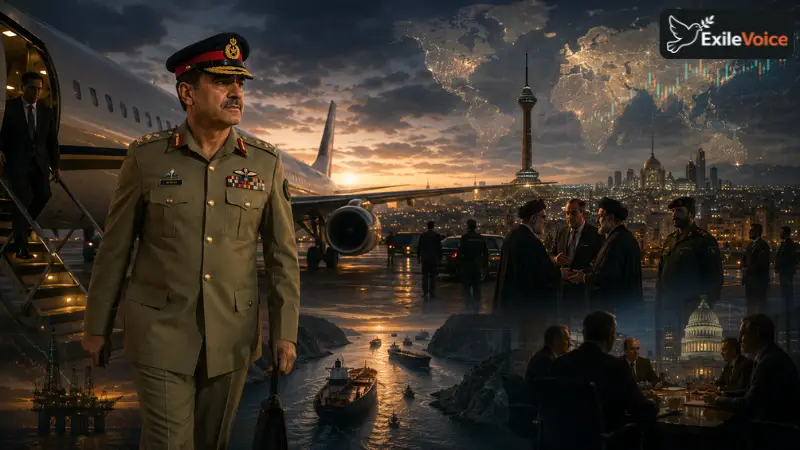
The strategic theater of the Middle East is witnessing a highly technical realignment, crystallized by the sudden appearance of Pakistan’s Chief of Army Staff, General Asim Munir, in Tehran. Historically, Pakistan’s state apparatus has navigated structural crises at home, yet on the international stage, its military high command remains an influential asset for great-power communication. Global markets reacted instantly to confirmed operational details of Munir’s landing. Energy desks and quantitative trading systems in New York and London interpreted the development as an acceleration of sensitive, back-channel diplomacy between Washington and Tehran. This immediate financial sentiment underscores a complex geopolitical paradox: a defense headquarters heavily scrutinized for domestic internal controls is simultaneously leveraged by global superpowers as an irreplaceable intelligence and diplomatic pipeline.
This dynamic was highlighted by explicit messaging from Western diplomatic networks, specifically signaling that Islamabad operates as the primary contact conduit for containing broader regional kinetic escalation. The diplomatic runway for General Munir’s mission was systematically mapped out during the preceding weeks through three distinct, low-profile operational deployments led by Pakistan’s Interior Minister, Mohsin Naqvi. Naqvi’s assignments were designed to establish high-level protocols directly with Iran’s structural security core: the Islamic Revolutionary Guard Corps (IRGC). By engaging the top leadership of the IRGC, the architect of Iran’s regional operational capabilities and domestic defense infrastructure, Pakistani planners bypassed conventional bureaucratic blockages to establish direct, military-to-military communication lines.
The physical re-emergence of senior IRGC command elements in official diplomatic photographs alongside Pakistani officials serves as a significant indicator that a highly coordinated, multi-state security protocol is in effect. These entities, long prioritized by Western defense networks for containment, are now actively engaging in structural mediation. This tactical de-escalation is further demonstrated by shifting maritime tracking data in the Strait of Hormuz. Commercial vessel transits have scaled upward sequentially, moving from baseline lows to increased daily passages. This operational normalization within the world's most critical energy transit corridor indicates that a temporary, unpublicized maritime security understanding has been achieved among regional and international actors.
Simultaneously, institutional intelligence frameworks reveal that Qatar has synchronized its veteran diplomatic team with the Pakistani mission, establishing a joint mediation cell in Tehran. Doha’s long history of managing sensitive back-channel communications between Western defense architectures and non-state or isolated state actors introduces an advanced layer of operational reliability. This institutional support minimizes structural friction, providing the diplomatic cover required to handle high-stakes security dossiers.
At the center of these ongoing discussions is the gradual, conditional unwinding of the international sanctions regime that has constrained Iran's economic infrastructure since 1979. These complex sanctions have broad structural consequences, directly limiting regional infrastructure projects, including the long-delayed Iran-Pakistan-India (IPI) natural gas pipeline. Western usage of extraterritorial sanctions has effectively checked regional energy integrations, altering the economic plans of neighboring states by restricting their trade options. If the current framework succeeds in establishing a verifiable verification mechanism under international oversight, the gradual removal of trade barriers could significantly alter global energy logistics, introducing substantial volumes of crude oil back into formal international markets.
Any potential framework will be governed by the United Nations Charter and relevant international legal standards, ensuring structural enforcement across both state signatories. As General Munir’s aircraft returns to Islamabad, the long-term survival of this negotiated framework will depend entirely on balancing Iran’s sovereign security demands with the strategic containment metrics required by Western capitals. While internal domestic questions surround Pakistan’s leadership, its military apparatus has once again demonstrated its utility as a primary security pipeline in global geopolitics.