

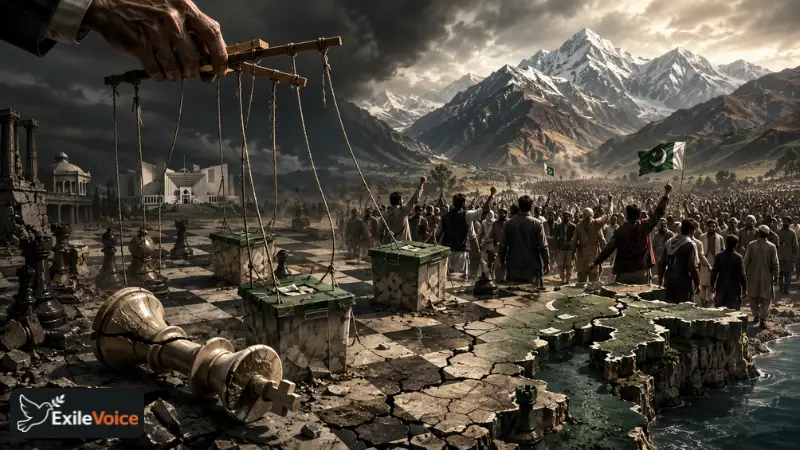
The political landscape of Pakistan is currently witnessing a significant breakdown of traditional "political engineering" tactics. For decades, the prevailing narrative suggested that certain institutional powers could make or break political careers with surgical precision. However, recent events in Gilgit-Baltistan and Kashmir suggest that this "playbook" is no longer yielding the desired results.
In Gilgit-Baltistan, particularly in Chilas, the registration of terrorism cases against PTI-backed candidates following election rallies has drawn international attention. This strategy, often used to suppress political activity, is proving counterproductive in sensitive border regions. Professionally, using heavy-handed legal charges in areas like GB and Azad Jammu & Kashmir (AJK) is a high-risk maneuver. These regions are geopolitical fault lines; internal instability there is quickly exploited by regional rivals like India to weaken Pakistan’s international stance on the Kashmir issue.
The "myth" of the kingmakers is also being challenged by public resilience. In the past, the strategy was simple: identify the winner and provide the institutional "push" required for a landslide. Today, despite numerous legal hurdles, incarceration of leadership, and the removal of party symbols, the public remains aligned with the narrative of the ousted Prime Minister Imran Khan. The inability of the current administration to build a popular alternative, despite significant investment in the image-building of leaders like Maryam Nawaz and Bilawal Bhutto, indicates a decoupling between institutional will and public sentiment.
Furthermore, the treatment of allies like Bilawal Bhutto-Zardari reveals the volatility of these engineered alliances. Reports suggest a cooling of relations between the PPP leadership and the establishment, with rumors of constitutional amendments aimed at clipping the wings of provincial powers. This constant shifting of support suggests a lack of a long-term vision for national stability.
The path forward for Pakistan requires a departure from these coercive tactics. Security-centric governance in political matters has historically led to alienation. If the state continues to treat political dissent as "terrorism," especially in sensitive regions, it risks not only domestic chaos but a strategic disadvantage on the global stage. The era where political outcomes could be dictated from a central "playbook" appears to be reaching an end, replaced by a more defiant and informed electorate.

