The constitutional status and political sentiment of Gilgit-Baltistan are undergoing a major shift, influenced by broader national political alignments. Historically, regional movements focused consistently on achieving full provincial integration with Pakistan, aiming to secure permanent financial allocations and legislative parity with the country's core provinces. However, field assessments from the 2026 electoral cycle show a unexpected trend: local demands for formal provincial status have substantially decreased.
This decline in provincial aspirations is tied directly to local reactions to federal enforcement operations across Pakistan's established provinces. Local political figures, including representatives from organizations traditionally aligned with federal coalitions like the Pakistan Muslim League-Nawaz (PML-N), express growing concern over the aggressive suppression of political dissent at the federal level.
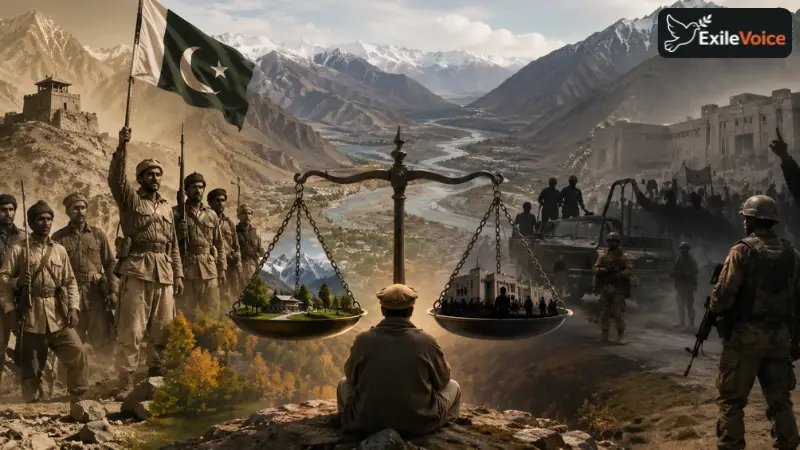
Local leadership observes that the systematic dismantling of opposition structures within the provinces has made full provincial integration less attractive. There is a widespread perception that under the current centralized administrative model, achieving formal provincial status would expose Gilgit-Baltistan to intrusive federal control, undermining its remaining local administrative protections. Consequently, local leaders are prioritizing regional autonomy over formal provincial integration to shield local politics from external federal volatility. This constitutional dilemma is rooted in Gilgit-Baltistan's unique historical path into the federation. Unlike the regions that automatically integrated into Pakistan during the August 1947 partition, Gilgit-Baltistan's entry was achieved through a localized military revolt against the Dogra dynasty. Following the Maharaja's declaration of accession to India on October 26, 1947, the Gilgit Scouts, commanded locally by British officer Major William Brown, staged an armed uprising, detained the regional governor Ghansara Singh, and raised the Pakistani flag on November 2, 1947.
This autonomous historical path highlights a long-standing political contradiction. Gilgit-Baltistan voluntarily joined Pakistan through local military action rather than legislative agreements. Despite this history of proactive integration, contemporary federal policy often treats the territory as an administrative dependency, frequently interfering in local electoral processes. When federal authorities disrupt local elections, they risk undermining the foundational relationship between the region and the state, potentially transforming a historically loyal territory into a source of regional instability.