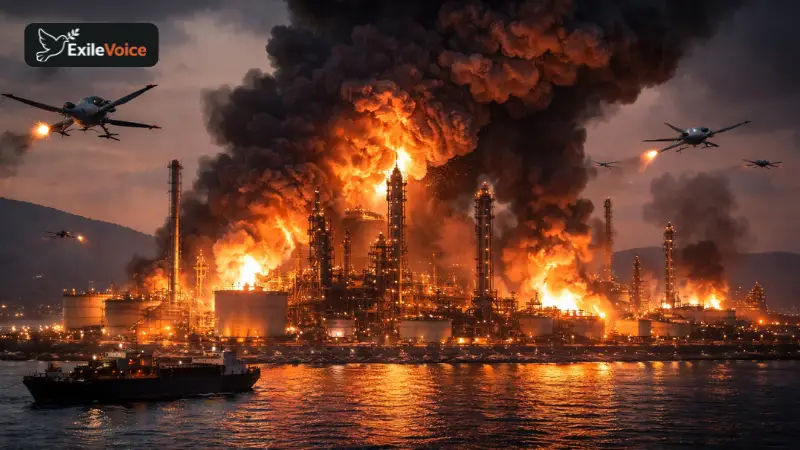
The Middle East has entered a precarious new phase of conflict characterized by direct hits on high-value energy assets. Recent developments indicate that the "shadow war" between regional powers has spilled over into overt kinetic actions, specifically targeting refinery capacities and gas facilities that form the backbone of the global energy market. Reports confirm that following an initial strike on Iran’s "Pars" gas facility, an attack that some intelligence sources suggest was executed with at least the tacit awareness of Western powers, Iran has retaliated with precision.
The Iranian response has focused heavily on the Red Sea corridor and Saudi Arabia’s strategic bypass routes. For decades, Saudi Arabia relied on the Strait of Hormuz for its oil exports. Fearing a blockade, the Kingdom invested heavily in a massive trans-peninsular pipeline ending near the Red Sea. However, Iranian-backed drone strikes have recently successfully targeted these Red Sea refineries. One major facility, capable of processing 400,000 barrels per day, was reportedly hit, alongside two other refineries in the region with a combined capacity of 800,000 barrels. This total disruption of roughly 1.2 million barrels of processing capacity mimics Iran’s own total export volume, signaling a "tit-for-tat" strategy designed to show that if Iran cannot export its energy, neither will its neighbors.
The diplomatic fallout from these strikes has been swift but arguably one-sided. A recent summit of foreign ministers in Riyadh, including representatives from Turkey, Pakistan, Egypt, and Jordan, issued a stern warning to Iran, demanding an immediate cessation of hostilities against Gulf nations. However, the communiqué was notably silent regarding the initial strikes on Iranian soil by Israel or the involvement of the United States. This perceived lack of balance in diplomatic condemnation further complicates the path toward a ceasefire, as Iran views these regional bodies as extensions of Western interests rather than neutral mediators.
Simultaneously, the economic impact is being felt globally. Following the strike on Qatar’s gas infrastructure, European gas prices surged by 30%. Brent crude has fluctuated around the $112 per barrel mark, with analysts warning that a sustained closure of shipping lanes or continued refinery fires could push prices toward the $200 threshold. The current situation suggests that as long as the core energy "windpipes" of the West are under threat, international pressure for a resolution will remain high, yet the lack of a balanced diplomatic framework continues to fuel the cycle of retaliation.