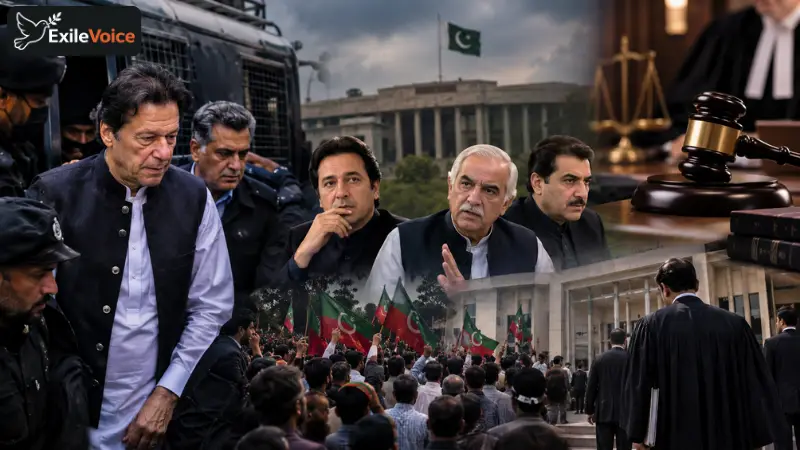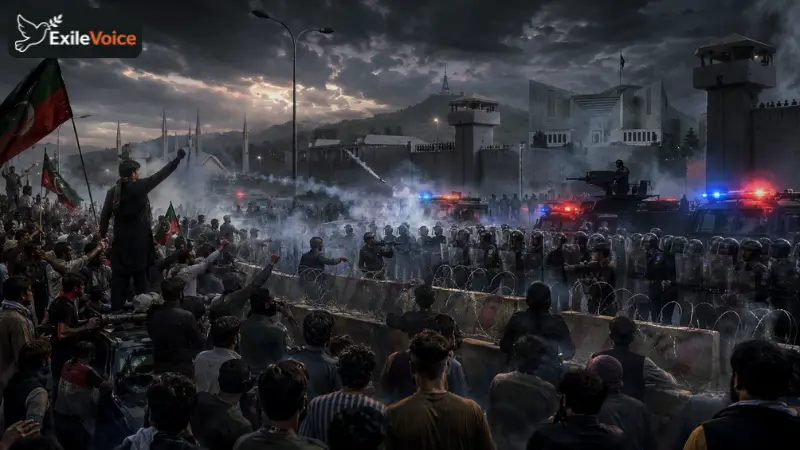
The political landscape of Pakistan has entered an volatile phase characterized by an increasing reliance on state-sanctioned force, a systemic breakdown of historical political decorum, and deep-seated institutional anxiety within the ruling establishment. The recent events of May 19, 2026, outside the periphery of Rawalpindi near the Chungi 26 transit point, underscore this shifting dynamic. What was intended to be a political assembly led by the Chief Minister of Khyber Pakhtunkhwa, alongside family members of the incarcerated former Prime Minister Imran Khan, transformed into a heavily militarized containment zone. The deployment of aerial firing, rubber projectiles, and persistent chemical crowd-control agents by Islamabad and Rawalpindi police forces highlights a departure from traditional governance methodologies toward an unyielding, overt security posture.
To understand the gravity of these clashes, one must examine the erosion of historical political boundaries within the country. Historically, Pakistani political friction, even during periods of overt military rule or hybrid administrations, observed a calculated set of unwritten boundaries. While state force was frequently deployed against ideological dissidents or religious extremists threatening sensitive perimeters, such as the federal Capital’s Red Zone, the direct application of physical violence against sitting provincial chief executives and cabinet ministers was historically avoided to prevent complete state polarization. The historical precedent for stringent perimeter security dates back to the structural hardening of the capital following the 1979 American Embassy siege. Since that era, kinetic state responses were strictly reserved for instances where international diplomatic missions or core state infrastructure were actively threatened.
The current administration’s decision to dismantle these protocols indicates a profound sense of institutional vulnerability rather than absolute authority. By subjecting a sitting provincial Chief Minister and a regional cabinet to physical blockades and direct kinetic actions, the current administration, frequently referred to as the Sharif-Zardari-Asim institutional axis, is signaling an absolute lack of political flexibility. This rigid posture stems from a tactical calculation: the regime views any concession, even a humanitarian or regulated family meeting with a political prisoner, as a sign of weakness that could trigger an uncontrolled shift in public momentum. Consequently, the regime is caught in a cycle where maintaining authority requires escalating levels of physical enforcement, further detaching the center from regional federating units.
Simultaneously, the opposition structure is undergoing a significant strategic evolution, transitioning from spontaneous public resistance to a structured institutional and economic campaign. Following the denial of access at Adiala, the political leadership under the banner of the Tehreek-e-Tahaffuz-e-Aine-Pakistan, a constitutional coalition led by veteran politicians such as Mahmood Khan Achakzai, alongside senior figures like Asad Qaiser and constitutional expert Barrister Aitzaz Ahsan, has coordinated a nationwide strike aligned with the upcoming federal budget cycle. By merging demands for judicial access and prisoner healthcare with systemic economic grievances such as inflation, energy tariffs, and fuel price hikes, the opposition is shifting the conflict from a singular personality-driven movement into a broad-based socio-economic front. This alignment leverages the budget season to maximize economic leverage against an administration already grappling with fiscal stabilization challenges.
Behind this public confrontation, complex undercurrents of track-two diplomacy and pragmatic political realignments are developing. Reliable accounts indicate that secondary leadership tiers within the opposition are actively engaging in backchannel discussions with representatives of the state infrastructure to negotiate parameters for political de-escalation, potential medical transfers, and eventual residential relocations for key detainees. Furthermore, the strategic coordination between the Pakistan Tehreek-e-Insaf and the Pakistan Peoples Party regarding the proposed 28th Constitutional Amendment demonstrates the highly pragmatic nature of Pakistani statecraft. This development illustrates a fundamental political reality: in times of structural crisis, long-standing ideological and personal rivalries are frequently set aside in favor of tactical alignments designed to preserve institutional influence. The contemporary political environment proves that absolute, unyielding polarization is unsustainable; survival within the state apparatus ultimately demands a transition toward calculated legislative and constitutional bargaining.