

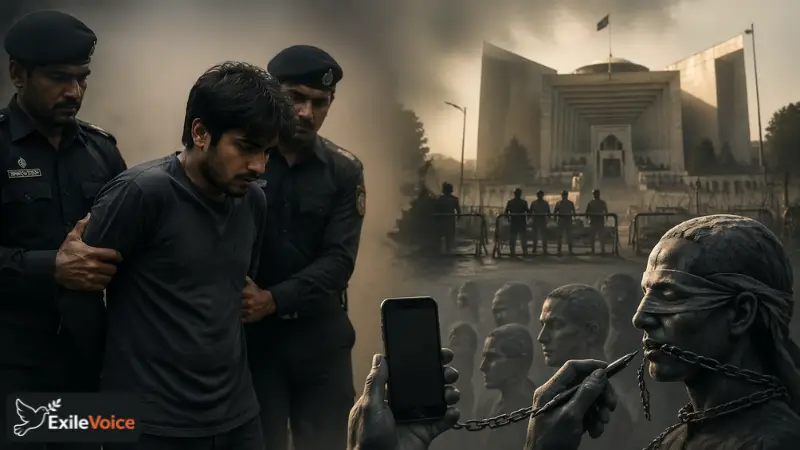
In recent months, the landscape of free expression in Pakistan has undergone a profound and troubling transformation. The fundamental right to dissent and the ability to engage in metaphorical or critical discourse are increasingly being met with the full force of the state’s legal apparatus. A striking example of this trend is the recent arrest of a young man, Khurram Nazir, in Islamabad. His offense was not an act of violence or a call to arms, but a social media post that used a geographical metaphor, likening a local railway crossing (Tarnol Phatak) to the strategic Strait of Hormuz, to highlight local grievances regarding electricity and water shortages.
This incident serves as a chilling case study in the "securitization" of public speech. By filing a First Information Report (FIR) and making an arrest based on a symbolic comparison, the state sends a powerful message: even the use of intellectual metaphors to advocate for basic human rights is now a high-risk activity. This environment of "enforced silence" is not merely about suppressing political opposition; it is about dismantling the psychological space required for independent thought. When a railway gate becomes a matter of national security due to a social media caption, the boundary between governance and absolute control becomes dangerously blurred.
Historically, even under colonial rule, the legal threshold for sedition or public disorder was often higher than what is being witnessed today. The current strategy appears to be one of "preventative intimidation," where the arrest of one individual serves as a deterrent for an entire community. This systematic approach, which includes home raids, property damage, and the misuse of Section 144 (which prohibits public gatherings), aims to create a society that is too fearful to ask questions.
The long-term implications for Pakistan's democracy are severe. When the state treats intellectual expression as a criminal act, it pushes legitimate grievances underground. Professional analysis suggests that such extreme measures often backfire, as they strip the government of its perceived legitimacy both domestically and internationally. For a nation that was founded on the promise of constitutional freedom, the current trajectory toward hyper-regulation of thought represents a significant departure from its democratic ideals.

