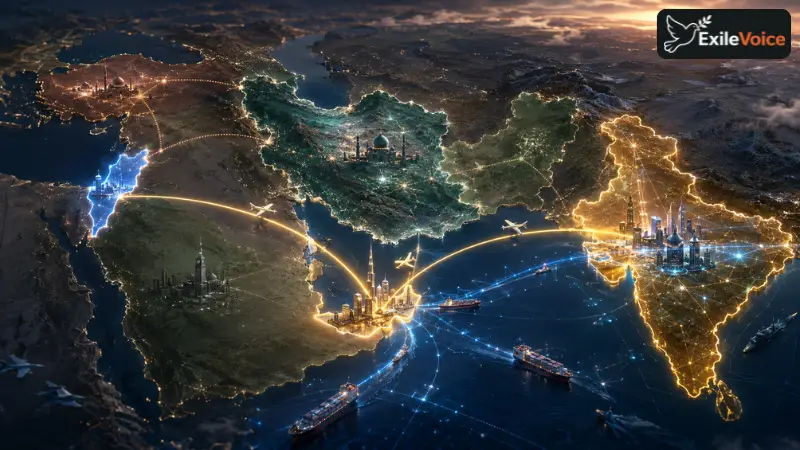
The Middle East is currently undergoing a profound transformation that transcends the immediate conflicts observed on the news. A new regional order is crystallizing, driven by the melting of traditional American influence and the rise of mid-level powers seeking to secure their own strategic interests. At the heart of this shift is an emerging axis comprising the United Arab Emirates (UAE), Israel, and India. This alignment is not merely a matter of diplomatic convenience but a structural response to a vacuum left by shifting U.S. priorities and the demonstrated resilience of regional actors like Iran.
Recent developments suggest that the UAE is actively diversifying its strategic partnerships. For instance, credible reports indicate that in late 2025, during high-level meetings between UAE leadership and Indian Prime Minister Narendra Modi, discussions pivoted toward a significant increase in reliance on Indian human resources while simultaneously reducing the footprint of Pakistani workers in the Emirates. This move is emblematic of a broader trend where the UAE sees India not just as a labor provider, but as a long-term strategic anchor in a volatile region. India, for its part, maintains a policy of "multi-alignment," avoiding formal mutual defense pacts but offering deep cooperation that reinforces its status as a rising global power.
Contrast this with the alignment forming between Pakistan, Saudi Arabia, and Turkey. While Turkey attempts to balance its role as a regional mediator, it is increasingly investing in its own military posture to protect its trading routes and energy supplies. The regional order is no longer a monolith; it is a fragmented landscape where national interests dictate fluid alliances. The UAE’s sensitivity regarding its international image remains a key lever for diplomacy. Despite its authoritarian internal structures, the UAE spends hundreds of millions of dollars on global lobbying to maintain a human-centric facade. Understanding this sensitivity is crucial for regional players like Pakistan, who must navigate these changes not through denial, but through sophisticated engagement and moral pressure.
The resilience of Iran throughout forty days of intense military pressure has served as a wake-up call for the Indian and Pakistani military establishments. The realization that even a superpower like the U.S. finds it difficult to sustain a conflict with a well-prepared regional power has emboldened middle powers to take more autonomous stances. As the "Regional Order" melts and reforms, the old rules of engagement are being rewritten by those who control the maritime routes and the human capital of the 21st century.