

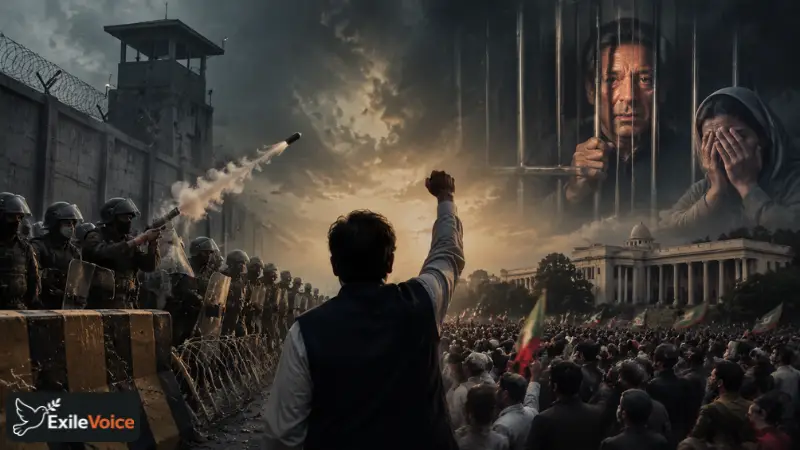
The escalating tension between opposition forces and the de facto military establishment in Pakistan highlights a profound institutional crisis. The ongoing confrontation at the gates of Adiala Jail, where political leaders, family members, and legal teams are routinely denied constitutional access to incarcerated former Prime Minister Imran Khan, exemplifies how the state's security apparatus is systematically weaponized to achieve specific political outcomes. The physical intimidation of peaceful workers, the deployment of kinetic force, including the firing of rubber bullets, and the deliberate obstruction of legal visitations reflect a broader strategy designed to break the morale of the country's primary opposition party, the Pakistan Tehreek-e-Insaf (PTI). Rather than adhering to the prison manuals and statutory regulations that govern judicial detentions, the state has opted to enforce an opaque, security-driven blockade, effectively transforming a judicial detention into a highly politicized isolation campaign.
This high-intensity friction was laid bare during a recent emergency press conference held at the Khyber Pakhtunkhwa (KP) House in Islamabad, where senior political figures and Khan’s sisters publicly denounced the administrative lawlessness of the federal establishment. The press conference, marked by sharp rhetoric and visceral frustration, documented the physical toll of state overreach on political dissidents. Prominent legal and political figures, including Sohail Afridi, voiced a growing consensus that the federal government's actions have completely bypassed constitutional boundaries. The systemic refusal to allow medical check-ups or legal consultations for the former prime minister and his spouse, Bushra Bibi, indicates that the legal framework is no longer operating independently. Instead, it has been subjugated to the tactical requirements of a regime relying on the controversial "Form 47" mandate, a term that has become synonymous with the alleged large-scale electoral engineering of the February 2024 general elections.
However, the internal dynamics of the opposition party during these moments of severe external pressure reveal their own structural vulnerabilities. A chaotic incident during the same KP House press conference involving the physical manhandling of a veteran female party worker, Nadia Khattak, by a junior party lawyer, Fateh Ullah Burki, exposed a problematic subculture driven by digital optics and media visibility. In the modern hyper-mediated political landscape of Pakistan, proximity to top-tier leadership inside the camera frame has become a valuable currency for political survival and advancement. This obsession with "framing" and public visibility frequently leads to toxic internal competition, where institutional discipline breaks down in favor of individual optics. The failure of senior leadership present on the stage to immediately intervene and protect a dedicated female cadre underscores a broader institutional gap: while the party is highly effective at mobilizing public sentiment against state oppression, it struggles to maintain rigorous internal administrative discipline and safeguard the dignity of its frontline workers under pressure.
From a structural perspective, this dual reality, external state coercion coupled with internal organizational volatility, threatens the long-term stability of Pakistan's democratic fabric. When the state apparatus uses raw force to suppress political dissent, it drives political movements into a corner, making compromises nearly impossible. Simultaneously, when political parties allow their internal operations to be governed by media sensationalism and optical competition rather than institutional rules, they compromise their ability to govern effectively or present a coherent alternative to the prevailing establishment. As the confrontation deepens, the total erosion of institutional boundaries within both the state and the political parties suggests that Pakistan is entering a highly volatile phase of political polarization, where traditional consensus-building mechanisms have completely collapsed.

