The sudden termination of veteran journalist Matiullah Jan from Neo News TV has reignited a fierce debate regarding the state of press freedom and the prevailing national narrative in Pakistan. Jan, widely regarded as one of the few journalists to maintain a consistent stance on the rule of law and democratic principles regardless of the party in power, found himself at the center of a controversy following a brief interaction with foreign journalists at the National Press Club in Islamabad.
The incident occurred during a visit by a delegation of foreign media personnel, where Jan commented on the harsh realities facing Pakistani journalists, including the arrests of colleagues and the climate of intimidation. This candidness was met with a swift backlash from state-aligned actors who accused him of "defaming the country" in front of foreigners. This reaction highlights a deeper psychological divide within the Pakistani polity: the conflict between the "Actual Pakistan" and the "Imagined Pakistan."
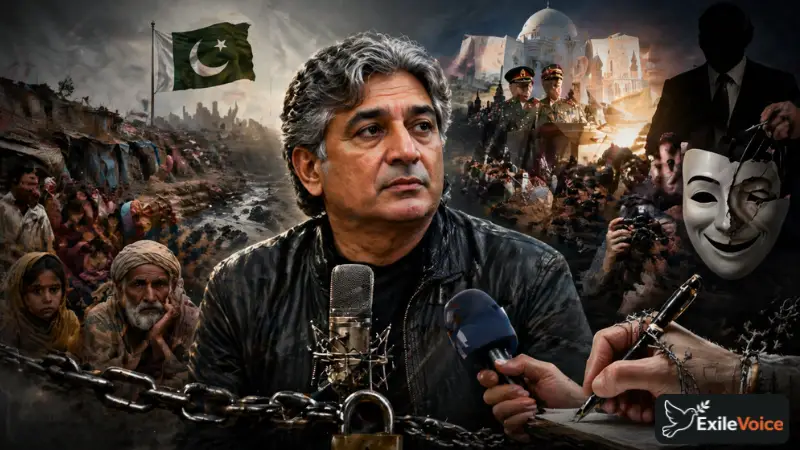
The "Imagined Pakistan" is a narrative of a regional powerhouse, an "Islamic Fortress" involved in high-stakes global mediation and grand historical destinies. This version of the country is fiercely protected by the establishment and its supporters, who view any public acknowledgement of domestic failure as an act of betrayal. In contrast, the "Actual Pakistan" is a nation of 250 million people, where over 200 million live without proper housing, healthcare, or nutrition. It is a country where the most basic infrastructure often fails, and economic survival is a daily struggle for the majority.
The backlash against Matiullah Jan is symptomatic of a culture that prioritizes "optics" over "substance." By pointing out that journalists are being silenced, Jan disrupted the carefully curated image of a stabilizing nation. The resulting professional reprisal against him, losing his position at a major news outlet, serves as a stark reminder of the "red lines" that exist for media professionals.
Comparatively, developed nations often thrive on self-critique, where journalists and academics are encouraged to challenge state policies to foster improvement. In Pakistan, however, self-correction is often viewed as a weakness to be exploited by external enemies rather than a necessity for internal growth. Until the state and the public can reconcile the "Imagined" glory with the "Actual" socio-economic crisis, the space for independent journalism will continue to shrink, leaving the country’s real problems unaddressed in the shadow of a manufactured narrative.