The glaring disconnect between the lifestyle of the ruling elite and the socio-economic realities of ordinary citizens has reached a boiling point in Pakistan. A striking manifestation of this divide was recently laid bare during the official visit of Punjab Chief Minister Maryam Nawaz to Azerbaijan. While the political establishment frames such foreign tours as crucial diplomatic grooming and international exposure necessary for future leadership, critics view the accompanying opulence as a tone-deaf display of expenditure in a nation teetering on economic collapse.
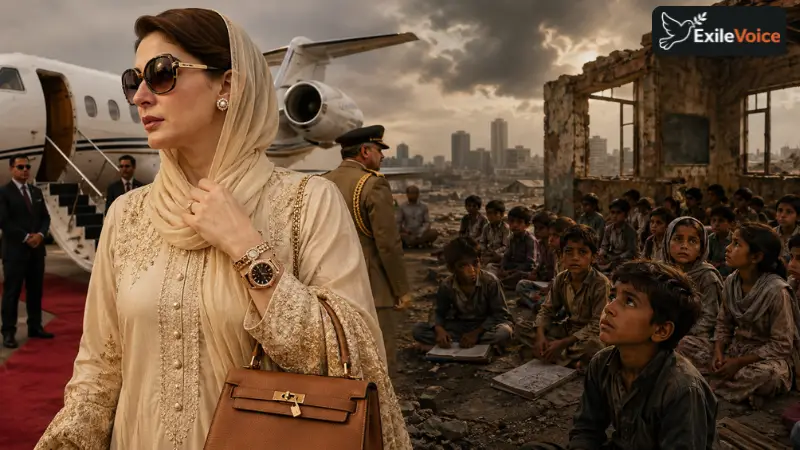
The Chief Minister’s trip involved a high-profile meeting with Azerbaijani President Ilham Aliyev, an event orchestrated to build her diplomatic credentials. However, the optics of the visit became a focal point of intense scrutiny. Public interest centered on the massive logistical and personal expenses involved, including the deployment of a state-funded aircraft valued at approximately 12 billion rupees. Investigative breakdowns of the Chief Minister’s wardrobe and accessories further fueled public outrage, revealing luxury items ranging from a multi-million rupee Patek Philippe wristwatch and a Bulgari Serpenti bracelet to high-end Dolce & Gabbana footwear and an Hermès Kelly handbag that collectively cost more than what an average Pakistani citizen earns in several lifetimes.
This immense display of wealth occurs against the backdrop of a catastrophic breakdown in the provincial public education sector. Data presented before the National Assembly by the Federal Minister for Education and Professional Training, Khalid Maqbool Siddiqui, highlights a grim reality. Pakistan is currently facing an unprecedented educational emergency, with over 25 million children out of school nationwide. Tragically, Punjab, the region under Maryam Nawaz’s direct executive control, is the worst offender, accounting for an astonishing 9.6 million out-of-school children.
The juxtaposition of a multi-billion rupee private jet and million-rupee personal accessories with nearly 10 million children deprived of basic schooling in the same province exposes a severe crisis of governance priorities. Educational experts and civil society organizations argue that the resources spent on administrative luxuries and image-building campaigns could significantly alter the trajectory of the province's failing public school system. Instead of investing in school infrastructure, teacher training, and modern learning tools, the provincial treasury remains heavily skewed toward maintaining the standard of living of the ruling elite.
Furthermore, this governance model relies heavily on a system of patronage and rewards rather than meritocracy. In Punjab, key administrative and regulatory bodies are frequently staffed not by specialized professionals, but by retired military or bureaucratic figures as compensation for past services. A notable example includes the appointment of a retired Major General, who previously served in the Military Intelligence during critical accountability investigations against the ruling family, to a highly lucrative and influential position within the Punjab Public Service Commission. Such appointments solidify a culture where state institutions are used to preserve elite power, while foundational public services like education are left completely starved of funding.
The long-term implications of this structural neglect are profound. Leaving nearly 10 million children illiterate in Punjab alone guarantees the cycle of poverty and economic stagnation will continue for generations. As long as state resources are directed toward foreign luxury travel and political patronage rather than human capital development, Pakistan’s administrative apparatus will continue to serve the few at the expense of the many. The current crisis demands an immediate, radical shift in budgetary allocations, prioritizing classrooms over private jets, and public welfare over elite preservation.