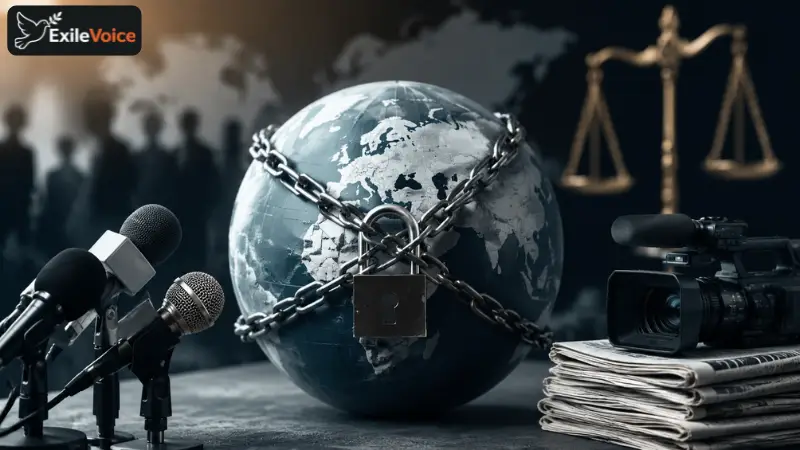
The structural integrity of democratic oversight and the global commitment to press freedom are facing a severe crisis of legitimacy across both Western and non-Western societies. This institutional breakdown is evident in how traditional accountability mechanisms are failing when confronting powerful state actors. A powerful case study occurred during the recent international tour of Indian Prime Minister Narendra Modi in Scandinavia, specifically within Norway, a nation that consistently ranks number one globally on the World Press Freedom Index. During a high-profile press conference in Oslo, Norwegian investigative journalists attempted to break through the tightly controlled public relations layer surrounding the Indian delegation by asking direct, critical questions regarding human rights regressions, minority targeting, and media suppression within the South Asian state.
Rather than engaging with these standard democratic inquiries, the Indian diplomatic corps and senior executives reacted with visible hostility. Top-tier diplomats lost their composure, aggressively interrupting journalists, attempting to unilaterally seize control of the press proceedings, and eventually staging an abrupt walk-out from the live conference. This stark display of diplomatic evasion highlights a growing global trend where powerful states, accustomed to dominating and intimidating compliant domestic "lapdog" media networks, are entirely incapable of managing independent, unregulated international journalistic scrutiny. This reliance on manufactured public relations and the outright refusal to submit to transparent questioning fundamentally undermines the core purpose of a free press as a critical check on state power.
Simultaneously, a terrifying example of the real-world consequences of unchecked media bias and political radicalization occurred in the United States. A group of heavily radicalized American teenagers carried out a brutal, pre-planned assault inside a mosque, murdering three innocent Muslim worshippers. Mimicking the tactical execution of the Christchurch massacres in New Zealand, the perpetrators wore body cameras to live-stream the entire slaughter onto mainstream digital platforms, showcasing weapons adorned with right-wing extremist, neo-Nazi symbols, and explicit drawings of the swastika.
Despite the horrific nature of this targeted hate crime, a deafening silence has persisted among senior American conservative and Republican political leaders. Prominent media personalities, such as British commentator Mehdi Hasan, have aggressively criticized this double standard in public morality during high-intensity debates with legacy figures like Piers Morgan. Hasan rightly points out that if a similar live-streamed terror attack had targeted any other religious minority, it would have provoked immediate, unconditional national condemnation and a total mobilization of federal counter-terrorism assets.
Instead, the response from far-right media figures, including influential commentators like Laura Loomer, has hovered close to explicit validation. They have utilized the tragedy to argue that Islamic populations should be completely expelled from the United States. This dangerous convergence, where legacy diplomatic structures actively flee from independent journalistic oversight while mainstream political parties remain silent on explicit domestic terror attacks targeting specific minorities—demonstrates that the foundational ethics of global media accountability have been profoundly compromised. Public information spaces have been transformed into highly polarized tools for perception management, structural bias, and state propaganda.