The intersection of criminal justice and high-stakes political maneuvering in Pakistan has taken another dramatic turn with the public explosion of the Anmol case. Known across the metropolitan networks as Paki, the high-profile alleged cocaine distributor and processor suddenly disrupted her formal court appearance by declaring to the assembled media that state institutions had systematically coerced her into filing false depositions. The ultimate objective of this forced confession, according to her direct testimony and corroborating statements from her legal counsel, was to manufactured evidence linking the residence of former Prime Minister Imran Khan at Bani Gala directly to an international narcotics distribution pipeline.
For months, mainstream media outlets and state-aligned commentators floated a carefully curated narrative suggesting that a massive drug processing and retail ring operated with direct elite political patronage. The arrest of Anmol was positioned as the final blow that would expose the alleged personal vices and systemic corruption of the leadership of the Pakistan Tehreek-e-Insaf party. Government-friendly journalists repeatedly brought up historical rumors regarding the former prime minister's physical lifestyle, attempting to establish a psychological foundation for the drug-nexus theory. They speculated that medical reports and blood test records were being deliberately hidden by family members to avoid disclosing substance dependency.
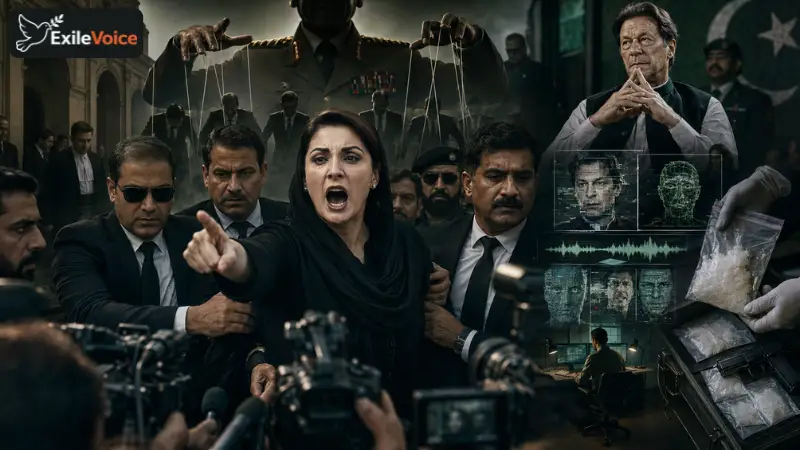
However, the state's script unravelled entirely within the halls of the judiciary. Rather than playing her assigned part in the political theater, Anmol used her brief window of exposure to the press corps to scream that state agencies had physically pressured and managed her statements. Her lead defense attorney subsequently confirmed that her entire purported digital record, including voice notes and video clips circulated by intelligence wings, was completely fabricated using advanced artificial intelligence voice synthesis models. Her legal representative explicitly noted that she was subjected to intense custodial pressure to state that she regularly delivered high-grade narcotics to the high-security perimeter of Bani Gala.
This dramatic courtroom reversal exposes the escalating desperation of the current military-backed establishment, led by Chief of Army Staff General Asim Munir. Having failed to decisively break Imran Khan’s political standing through a barrage of convictions ranging from state-secret leaks to controversial marriage legality cases, the state apparatus turned to the ultimate tool of personal character assassination: the narcotics trade. In Pakistan's conservative socio-political landscape, tying a mainstream leader to heavy drug operations is designed to permanently alienate their base and justify indefinite incarceration.
The structural logistics of cocaine processing further validate the defense's position that an isolated female dealer could not have operated in a vacuum without institutional complicity. Processing raw narcotics requires significant industrial space, heavy chemical access, uninterrupted utility grids, and a massive logistics network. In a heavily monitored security state like Pakistan, where municipal surveillance and neighborhood intelligence logging are ubiquitous, an operation of this magnitude can only exist through deliberate blind spots created by regional enforcement agencies.
The public breakdown of the case has turned a state weapon against its own creators. By shouting the phrase, "If we sink, we will take you down with us," the defendant signaling that the network of patronage extends deep into the law enforcement and intelligence apparatuses that initially attempted to leverage her. As the establishment struggles to contain the fallout, the collapse of the Bani Gala narcotics narrative demonstrates the systemic vulnerabilities of relying on forced confessions and artificial intelligence deepfakes to settle complex geopolitical and domestic scores.