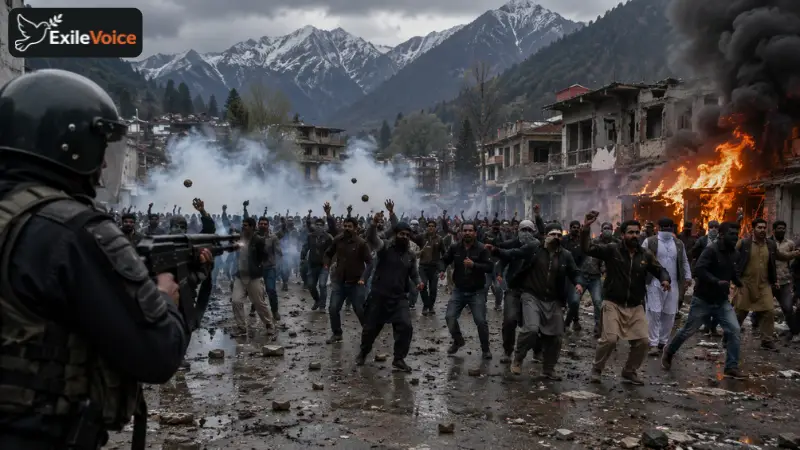
The sudden escalation of civil unrest and violence across Azad Jammu and Kashmir (AJK) marks a volatile turning point in the relationship between the region's population and the federal administrative apparatus of Pakistan. Triggered by deep-seated economic grievances regarding inflation, wheat subsidies, and electricity tariffs, a cross-party civil movement spearheaded by the Jammu Kashmir Joint Awami Action Committee (JAAC) has faced a severe state crackdown. Reports emerging from key sectors, including Rawalakot and Muzaffarabad, detail a heavy security presence, widespread internet blackouts, and direct kinetic interventions that have resulted in multiple casualties among both civilian protestors and state security personnel.
The humanitarian fallout of the crisis is compounded by a severe information vacuum. Local leaders, such as Shaukat Nawaz Mir of the Action Committee, have publicly accused federal security directors of exporting heavy-handed political suppression tactics into the valley. Eyewitness accounts and unverified reports from regional medical facilities describe overflowing hospitals, restricted movement for emergency services, and structural damage to residential areas due to urban clashes. While official figures remain conservative, regional activists claim civilian casualties are far higher than state admissions, drawing uncomfortable international parallels and providing fodder for foreign media outlets eager to highlight instability on Pakistan’s side of the Line of Control (LoC).
Beyond the immediate humanitarian concerns, the crisis exposes a profound lack of understanding among certain mainstream commentators regarding the delicate constitutional and diplomatic framework governing AJK. Prominent media voices in Islamabad have recently begun questioning the special status of AJK, complaining that while Kashmiris enjoy full commercial, property, and employment rights across Pakistan, Pakistani citizens face reciprocal restrictions on purchasing land or holding public office within Kashmir. These commentators have gone so far as to advocate for the formal, unilateral integration of AJK as a standard province of Pakistan, dismissing local resistance as ingratitude.
This line of argument represents a dangerous departure from Pakistan’s historic, UN-sanctioned stance on the Kashmir dispute. The distinct governance architecture of AJK, which features its own Prime Minister, President, Supreme Court, and Legislative Assembly, is not an administrative historical accident. It is a deliberate legal framework designed to maintain the region’s status as a recognized disputed territory under United Nations Security Council (UNSC) resolutions. By preserving AJK as an autonomous entity rather than a formal province, Pakistan maintains the legal high ground, arguing that the ultimate destiny of the entire Jammu and Kashmir region must be decided via a free and impartial plebiscite.
If Pakistan were to succumb to short-sighted domestic pressures and unilaterally alter the legal status of AJK or Gilgit-Baltistan to absorb them as provinces, it would effectively mirror India’s highly criticized August 2019 revocation of Article 370. Such a move would dismantle Pakistan's long-standing diplomatic case before the international community, validating the argument that both nuclear-armed neighbors view the territory through a lens of administrative annexation rather than self-determination. The current heavy-handed security approach not only alienates a historically loyal population but directly undermines the foundational foreign policy narrative that Pakistan has presented to the world for over seven decades.