The long-standing geopolitical impasse surrounding Pakistan's political landscape has been fundamentally altered following an explosive unredacted document leak by the investigative journalism outlet, Drop Site News. For nearly four years, the state-sanctioned narrative in Islamabad vehemently dismissed former Prime Minister Imran Khan’s allegations of a foreign-backed regime change operation. The official consensus from the diplomatic corps and military establishment maintained that the controversial document, historically referenced as the "Cipher", was merely a standard diplomatic correspondence blown out of proportion for domestic political gains. However, the comprehensive, sentence-by-sentence disclosure of the three-page cable has radically disrupted this status quo, offering profound insights into the mechanics of deep-state diplomacy and vindicating the claims originally made by Pakistan Tehreek-e-Insaf (PTI).
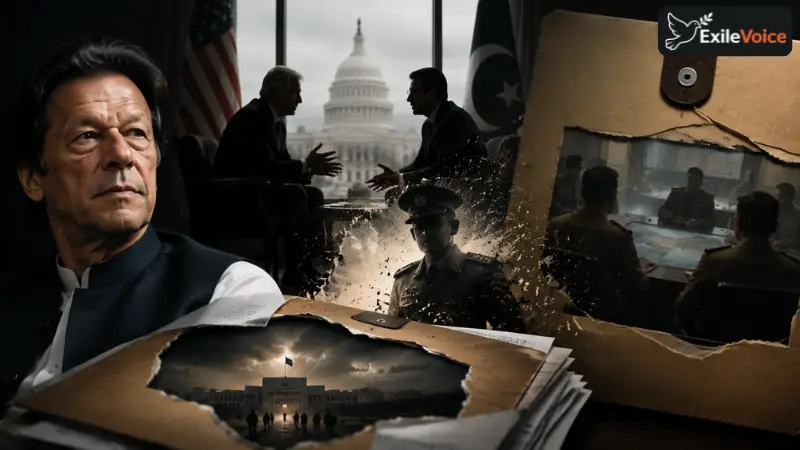
At the heart of this historical development is the definitive confirmation of external pressure applied by U.S. State Department official Donald Lu during a meeting with the then-Pakistani Ambassador to the United States, Asad Majeed Khan. The newly surfaced unredacted portions expose explicit text confirming that Washington viewed Imran Khan’s neutral foreign policy stance, particularly his bilateral visit to Moscow during the outbreak of the Russia-Ukraine conflict, as an unforgivable institutional departure. The text explicitly outlines that if the vote of no confidence against the prime minister succeeded, "all would be forgiven" in Washington, whereas survival of the political onslaught would lead to severe diplomatic isolation from both the United States and its European allies.
Beyond the external pressure, the structural layout of the leaked document breaks a major news story concerning the internal mechanics of Pakistan's military establishment. The final page of the document displays critical routing data detailing exactly who received copies of this highly classified cable from Washington. The distribution list included the Secretary to the Prime Minister, the Foreign Secretary, the Chief of Army Staff (COAS) General Qamar Javed Bajwa, and the Director General of the Inter-Services Intelligence (DG ISI).
Crucially, investigative forensics indicate that the specific copy leaked to international journalists originated from military intelligence archives rather than civilian or diplomatic offices. Analysts suggest that the document was provided by a deeply dissatisfied internal source within the security apparatus, an officer frustrated by the systemic lack of transparency and the heavy-handed institutional treatment meted out to democratic leaders. This structural leak effectively demonstrates an unprecedented internal fracture within the deep state, indicating that elements within the security apparatus are no longer willing to uphold decades of political engineering.
The broader implications of this development are sending shockwaves through Pakistan’s legal and institutional frameworks. For years, independent journalists who dared to probe the authentic contents of the cable faced severe state crackdowns, anti-terror charges, and forced exiles. The shocking disclosures now call into absolute question the foundational legal basis of the high-profile trials that convicted civilian leaders under the Official Secrets Act. With the authentic text fully available in the public domain, the narrative that the cipher was an engineered "drama" or a fabricated political stunt has completely disintegrated. This paradigm shift leaves the current ruling coalition and the retired military command facing a severe crisis of credibility as the public confronts visible, documented evidence of institutional deception.