

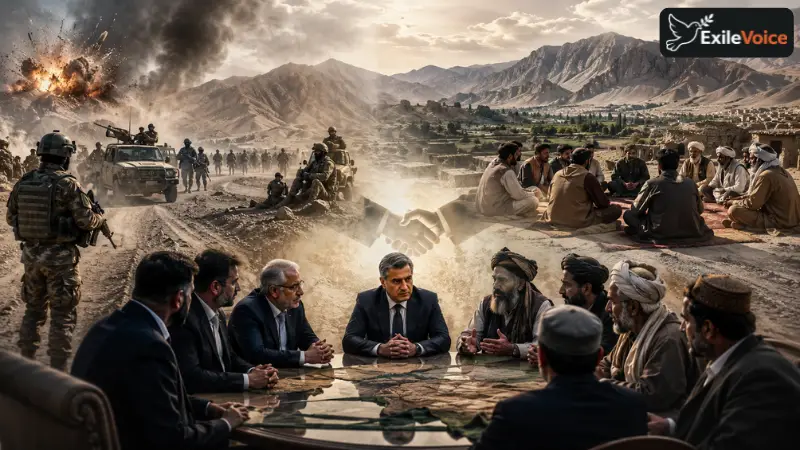
The recent surge in violence across Balochistan, specifically during the period from July 5th to July 8th, 2026, marks a critical escalation in the region's security environment. Attacks targeting Pakistani law enforcement and military personnel in Quetta, Ziarat, and Bela Winder have highlighted the persistent and evolving threat posed by militant groups, including the Tehreek-e-Taliban Pakistan (TTP) and the Balochistan Liberation Army (BLA).
The official response, exemplified by the press conference held by the Director General of Inter-Services Public Relations (DG ISPR), underscores the severity of the situation. While official narratives often emphasize a commitment to neutralizing militant threats, analysts suggest that these incidents reflect deeper, systemic issues that transcend conventional military solutions. The tactical sophistication demonstrated by militants, such as the abduction and subsequent actions involving security personnel, indicates a significant challenge to regional stability.
A central point of contention in the official discourse is the alleged external support for these militant groups, with authorities frequently pointing toward Indian involvement. Historically, claims regarding a nexus between Indian intelligence agencies and various militant factions, such as the BLA and TTP, have been a cornerstone of Pakistan’s security narrative. However, critics argue that a purely reactive, security-centric approach fails to address the underlying political grievances of the Baloch population.
The core of the issue lies in the perception of resource exploitation and the lack of political representation. The Baloch people have long expressed concerns regarding the extraction of local minerals and the terms of economic contracts with foreign entities, often feeling marginalized in the decision-making process. The recent All Parties Conference (APC) held in Islamabad, featuring representatives from various political factions including the Pakistan Tehreek-e-Insaf (PTI), highlighted the necessity of a political resolution. The consensus among these stakeholders is that the crisis in Balochistan is fundamentally a political, not merely a security, issue.
Moving forward, effective conflict resolution requires a dual strategy. Internally, there must be a move toward a broad-based political dialogue, ensuring that the Baloch population’s aspirations are represented through legitimate, transparent governance. Externally, there is a clear imperative for sustained diplomatic engagement to manage regional tensions. Relying solely on a reactive, security-first mindset without fostering political inclusion risks perpetuating the current cycle of instability. Achieving long-term peace in Balochistan necessitates moving beyond accusatory rhetoric and embracing a more nuanced, inclusive political framework that prioritizes the rights and voices of the local population.

