

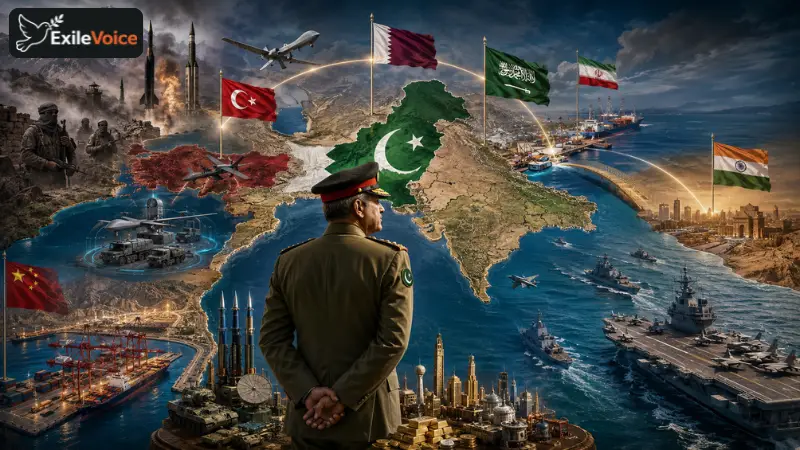
Under the centralized stewardship of Chief of Army Staff General Asim Munir, Pakistan’s foreign policy is undergoing a profound structural recalibration. Faced with a fracturing domestic economy and intense regional isolation, the Pakistani military establishment has pioneered a dual-track strategy combining aggressive security pacts with high-level counter-diplomacy. This geopolitical doctrine was put on full display with two simultaneous international developments: the rapid consolidation of a new quadripartite security alliance, colloquially termed the Islamic NATO, and the emergency deployment of Interior Minister Mohsin Naqvi to Tehran following shifting strategic postures between Iran and India.
The emerging Islamic NATO represents a calculated attempt to pool regional capabilities to protect against asymmetric security threats and economic vulnerabilities. The alliance brings together four distinct pillars: Pakistan, Turkey, Qatar, and Saudi Arabia. Each nation injects a unique strategic asset into the partnership. Pakistan provides the ultimate deterrent through its advanced nuclear weapons capability and battle-tested conventional ground forces. Turkey contributes its highly sophisticated military-industrial complex, offering indigenous drone technology, naval engineering, and advanced electronic warfare systems. Qatar and Saudi Arabia provide the essential economic fuel, deploying massive capital reserves and energy security to underwrite the alliance's joint operational costs.
While this security framework positions Pakistan as an indispensable military anchor in the Islamic world, the doctrine is facing a severe stress test on its western border. The sudden arrival of Pakistan’s Interior Minister Mohsin Naqvi in Tehran underscores deep anxieties within the Rawalpindi headquarters regarding Iran's shifting economic alliances. Naqvi, widely regarded as the civilian face of General Munir's inner circle, was dispatched immediately following public declarations by Iranian authorities regarding India's long-term access to the strategic Chabahar Port. Iranian diplomatic officials explicitly described Chabahar as India’s golden gate to Central Asia and Afghanistan, a direct geopolitical counterweight to the Chinese-funded Pakistani port at Gwadar.
This development is a direct blow to Pakistan’s regional containment strategy. For years, Islamabad relied on temporary diplomatic thaws with Tehran to manage cross-border militancy and minimize Indian footprint along the Arabian Sea. Tehran's public embrace of New Delhi, highlighted by warm diplomatic exchanges between Indian Prime Minister Narendra Modi and UAE President Mohammed bin Zayed, demonstrates that economic pragmatism is rapidly outpacing Pakistan's traditional security guarantees. The situation is further complicated by the fact that the UAE, which recently demanded the immediate repayment of vital central bank deposits from Pakistan, is actively funding infrastructure corridors that bypass Pakistani trade routes entirely.
Simultaneously, Pakistan’s western frontier is deteriorating due to the introduction of advanced weapon systems by the Tehreek-e-Taliban Pakistan. Security reports indicate that militant groups have acquired long-range precision missile systems, fundamentally altering the tactical landscape for Pakistani border regiments. General Munir’s doctrine must therefore navigate an incredibly complex chessboard: holding together a grand regional alliance with Turkey and the Gulf states, checking Indian naval encirclement via Iranian ports, and securing Western diplomatic validation from figures like US Congressmen Jack Bergman to preserve vital financial lifelines. The success of this strategy hinges on whether military diplomacy can offset Pakistan’s structural economic weaknesses.

