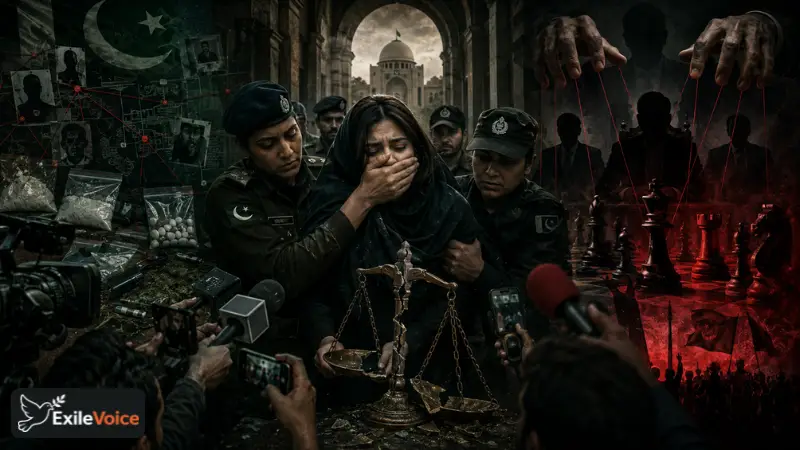
The intersection of high-profile criminal investigations and political warfare remains one of the most defining characteristics of the Pakistani governance framework. The unfolding narrative surrounding Anmol Pinky, a figure designated by state authorities as a central operative in an elite narcotics syndicate, serves as a poignant case study. What initially emerged within local media as a sensationalized crime story has rapidly transitioned into a highly calculated political instrument, reflecting a long-standing tradition of using criminal allegations to engineer political outcomes.
A critical observation of the judicial process reveals a striking dichotomy in how the accused has been managed by law enforcement. Initial public appearances depicted a highly differential, almost theatrical level of treatment within judicial premises, reminiscent of a choreographed media event rather than a standard criminal processing procedure. However, subsequent appearances marked a drastic shift. Footage emerged showing aggressive physical muzzling by police personnel, attempts to physically cover the face of the accused, and deliberate actions to prevent her from speaking to reporters. This structural transition from accommodation to absolute suppression signals deep institutional anxiety regarding the information the accused intended to make public.
During these chaotic court appearances, the accused explicitly alleged that she had been subjected to severe physical coercion and unlawful detention for over three weeks. Crucially, she asserted that state interrogators forced her to sign fabricated statements explicitly linking her illicit distribution network to prominent political figures residing in Bani Gala. By injecting the name of Bani Gala into a high-level narcotics probe, the state apparatus effectively attempts to transition a localized criminal investigation into an existential political scandal. This pattern is deeply familiar within Pakistani political history, where narcotics allegations have routinely been deployed to delegitimize popular political leaders and manipulate public sentiment.
From an institutional perspective, the mechanics of the arrest raise significant structural questions. While localized police forces executed the physical apprehension, deep analytical coordination came from a powerful federal entity, the Anti-Narcotics Force, an organization historically directed by active military leadership. The circumventing of standard provincial police protocols to isolate the target points toward a highly centralized operational design. In Pakistan, when a criminal enterprise operates successfully for years through the systemic bribery of provincial law enforcement, its sudden dismantle by a federal entity rarely stems from a pure law enforcement mandate. Instead, it typically indicates that the entity's network has crossed into territory that threatens or serves broader state-level strategic calculations.
The broader implications of this case expose the fragile nature of judicial integrity and rule of law in the country. When the state utilizes physical intimidation inside a court of law to prevent an accused individual from documenting allegations of torture, the boundary between legal enforcement and institutional overreach dissolves. Furthermore, the systematic reliance on narrative-driven investigations, where confessions are extracted under duress to build political leverage, undermines the credibility of the entire judicial system. As this legal battle continues to unfold, the actual dimensions of the narcotics trade remain overshadowed by the far more urgent state objective of consolidating political control and executing narrative warfare against political adversaries.