

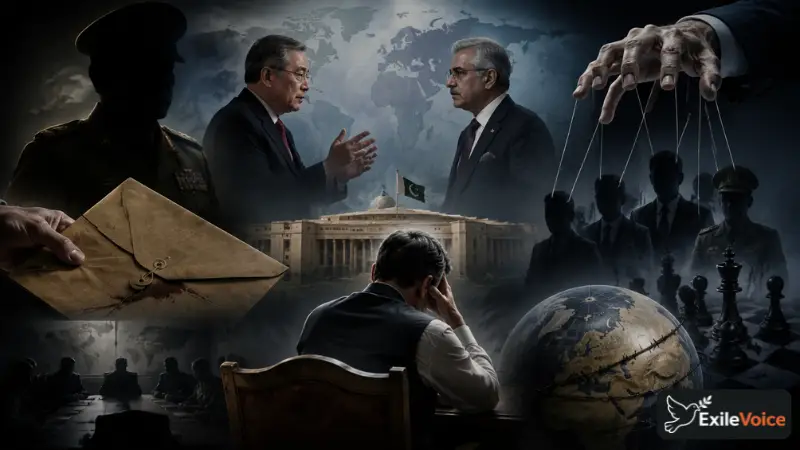
The relationship between domestic political stability and sovereign foreign policy has long been a foundational pillar of geopolitical analysis. However, when the structural mechanisms designed to protect a state's strategic communications are compromised or subverted by internal actors, the resulting institutional crisis can alter the trajectory of an entire nation. The recent, full-scale release of the authenticated diplomatic cable, colloquially known as the "Cipher", by the independent investigative journal Drop Site provides a rare, empirical case study into the mechanics of foreign diplomatic leverage, institutional insubordination, and the deliberate creation of executive communication blackouts.
The text of the cable outlines a meeting between the United States Assistant Secretary of State for South and Central Asian Affairs, Donald Lu, and the Pakistani Ambassador to the United States, Asad Majeed Khan. The core tension within this communication centers on the state’s decision to adopt a position of strict neutrality regarding the Ukraine-Russia conflict. Crucially, the transcript reveals a profound discrepancy in how this policy was understood. While internal diplomatic records confirm that Pakistan’s neutral stance was the product of extensive, deliberate inter-agency consultation involving all civilian and military stakeholders, foreign interlocutors actively mischaracterized the policy as an isolated, personal gambit by the Prime Minister. By isolating the head of government from the institutional consensus of his own state, foreign actors created a narrative framework where the removal of a single political figure could serve as a prerequisite for the normalization of bilateral relations.
The explicit linkage of the No-Confidence Motion to diplomatic reprisal or absolution represents a severe departure from established international norms. The cable notes that if the political process succeeded in removing the Prime Minister, "all sins would be forgiven," whereas a failure to displace the government would result in severe long-term consequences. This explicit framing occurred before the No-Confidence Motion was formally tabled or debated in the national parliament. The timing strongly suggests that external actors possessed granular visibility into ongoing domestic political machinations, or that the political transition was being actively incentivized as a policy objective.
Beyond the external pressure, the structural analysis of this event exposes a deeper, more alarming crisis within the state's executive framework: the weaponization of bureaucratic gatekeeping. A diplomatic cipher is a highly classified, encrypted communication meant to inform the executive leadership, specifically the Prime Minister, the Foreign Minister, and the cabinet, of critical national security threats. The evidence demonstrates that this vital communication was intentionally withheld from both the Prime Minister and the Foreign Minister for an extended period. This internal communication blackout was orchestrated by senior bureaucratic figures, including the Foreign Secretary, acting under the influence of the military command structure.
This systematic suppression of intelligence meant that the civilian leadership was kept blind to an immediate geopolitical threat, preventing them from mounting a timely diplomatic defense. When a state’s security and intelligence apparatus independently decides which information reaches the elected executive, the constitutional chain of command fractures. The civilian leadership is effectively decoupled from its executive authority, reducing the prime minister to a figurehead while de facto power shifts to unelected institutional actors. The subsequent public narrative deployed by the military’s media wing (ISPR) and senior generals, which alternated between denying the existence of the document and claiming that "interference" did not equate to a "conspiracy", reveals an active effort to manage the political fallout of a major constitutional breach. Ultimately, this crisis demonstrates that external interference cannot succeed in a vacuum; it requires internal institutional vulnerability. When the leadership of a nation's military and bureaucratic apparatus prioritizes political engineering over constitutional duty, the state's diplomatic defenses collapse from within. The public exposure of the Cipher strips away the veneer of institutional neutrality, revealing a coordinated effort to reshape a country’s foreign policy by disabling its democratic executive.

