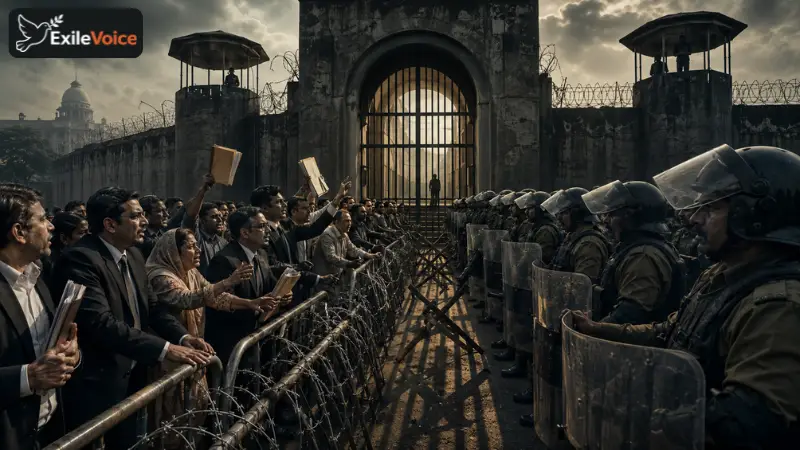
The ongoing political confrontation outside the gates of Adiala Jail highlights a fundamental shift in how the state manages political opposition and exercises judicial control. The prison has transformed from a standard correctional facility into a strategic center of executive deterrence. The persistent denial of visitation rights to family members, legal counsel, and political allies of incarcerated former Prime Minister Imran Khan represents a systematic effort to restrict institutional transparency and isolate opposition leadership. This containment strategy uses administrative protocols to bypass constitutional guarantees, turning routine legal procedures into tools of political control.
On the ground, this strategy relies on coordinated physical blockades and administrative delays. Elected provincial leaders and members of parliament face perimeter checkpoints, physical pushback, and mass arrests. When opposition members try to exercise their legal right to visit prisoners, security forces respond with rubber bullets and arbitrary detentions. This demonstrates an executive branch willing to use low-level kinetic force to prevent political mobilization. By labeling public interest inquiries and family medical updates as "political speech," state managers create an administrative justification for complete isolation. This tactical silencing prevents accurate information about the health and legal status of high-profile detainees from reaching the public, reducing accountability.
This administrative containment extends directly into the judicial system. The Supreme Court of Pakistan’s recent decision to return an opposition petition because it lacked the detained prime minister's signature demonstrates a complex procedural catch-22. Legal teams are denied the physical access required to obtain signatures, and the court uses that exact lack of documentation to reject their motions. This institutional impasse highlights a growing vulnerability within the state's legal framework: procedural technicalities can be weaponized to block access to constitutional remedies. When senior courts prioritize rigid administrative criteria over systemic rights violations, the judiciary risks validating executive overreach.
This institutional friction creates structural imbalances across the political system. Using state security forces to block access to legal counsel undermines the foundational principle of a fair trial. When political parties are forced to operate through restricted communication lines and ad-hoc press briefings, the broader democratic environment contracts. This model replaces standard political competition with state-directed administrative management, setting a dangerous precedent for future political transitions. Consequently, the standoff at Adiala is more than a localized security issue; it reveals a structural transformation where administrative rules are systematically deployed to manage political challenges.