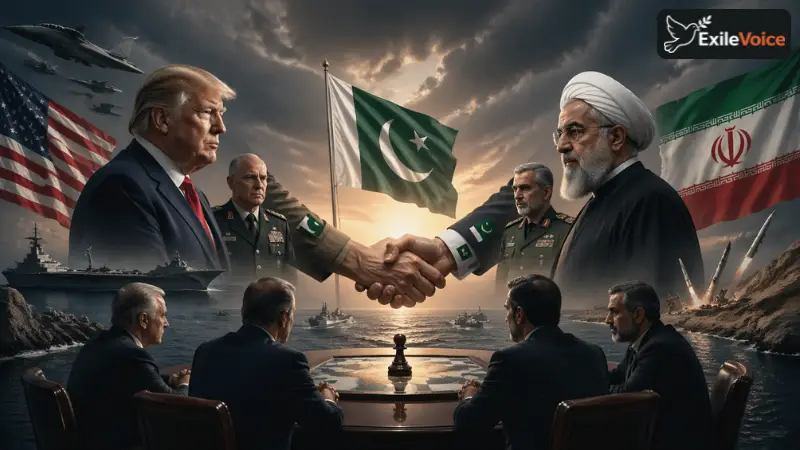
In a stunning reversal of aggressive rhetoric, President Donald Trump has announced an indefinite extension of the ceasefire with Iran, a move that many international analysts are labeling a "surrender" to geopolitical realities. This development, surfacing on April 21, 2026, marks a significant departure from the brinkmanship that characterized the early months of the year. The decision was notably influenced by direct requests from Pakistan’s military and civilian leadership, signaling a new era where Islamabad acts as a pivotal "Power Play" broker in Middle Eastern stability.
The mechanics of this ceasefire reveal a complex internal struggle within the White House. Reports have emerged suggesting that on the eve of the deadline, the U.S. administration faced a internal crisis. Some sources, including retired CIA analysts, claim that the President’s frustration nearly led to a request for nuclear codes, a move allegedly blocked by the Chairman of the Joint Chiefs of Staff. This internal restraint reflects a broader consensus within the U.S. establishment: there is no military solution that doesn't end in a "Vietnam-style" quagmire.
Pakistan’s role in this de-escalation cannot be overstated. For the first time in official U.S. communications, Field Marshal Asim Munir was cited as the primary contact, ahead of Prime Minister Shehbaz Sharif. This shift acknowledges the reality of Pakistan’s power structure and its unique ability to communicate across the ideological divide of Tehran and Washington. By facilitating this "face-saving" exit for the U.S., Pakistan has positioned itself not just as a regional ally, but as a necessary mediator in a multipolar world.
However, the ceasefire is far from a peace treaty. While the U.S. has halted direct kinetic strikes, it maintains a strict naval blockade, a move Iran views as an act of war. The Iranian leadership, specifically figures like Abbas Araghchi, remains deeply skeptical. Their reluctance to visit Islamabad for planned peace talks stems from a lack of trust in the Trump administration's "dishonest" track record regarding previous agreements. The current "stalemate" allows the U.S. to exit a potential war without offering the one thing Iran desperately needs: sanctions relief.