The geopolitical fallout of Pakistan’s 2022 regime change extended far beyond domestic political reconfigurations; it penetrated the sacrosanct domain of the country's strategic deterrent and defense posture. Fresh insights into the final months of General Qamar Javed Bajwa’s tenure as Chief of Army Staff (COAS) reveal an alarming pattern of unauthorized diplomatic offers made to Western capitals, threatening the long-term integrity of Pakistan's nuclear weapons program.
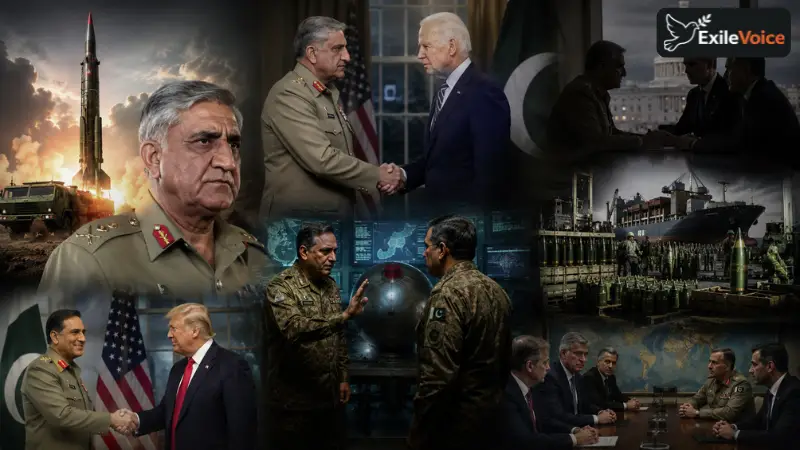
Immediately following the removal of Imran Khan's government in April 2022, the military establishment took a series of highly symbolic steps to signal a pivot back toward the Western strategic orbit. On the very day Khan was formally ousted, the military conducted a test launch of the Shaheen-3 ballistic missile. Boasting an operational range of approximately 3,000 kilometers, the Shaheen-3 is Pakistan’s most advanced and far-reaching strategic weapon system, specifically engineered to ensure full-spectrum deterrence capability reaching as far as Israel.
However, the real strategic shift occurred behind closed doors in October 2022, when General Bajwa embarked on an extensive farewell tour to Washington. Nominally a tour to repair strained bilateral relations, investigative details indicate that Bajwa sought a late-stage extension of his military command. To secure political backing and institutional blessings from the Biden administration, Bajwa reportedly offered unprecedented concessions regarding Pakistan’s nuclear delivery systems.
During high-level meetings with American defense and intelligence officials, General Bajwa proposed artificially downgrading the operational parameters of the Shaheen-3 missile. He explicitly promised U.S. interlocutors that Pakistan would modify and reduce the missile’s range to ensure it could no longer reach targets within Israel, effectively dismantling a core pillar of the country's defense strategy to appease regional Western allies.
Upon his return to Rawalpindi in late October, just weeks prior to his scheduled retirement in November 2022, General Bajwa attempted to execute this strategic rollback. He summoned the head of the Strategic Plans Division (SPD), the ultra-secretive, elite military directorate responsible for the research, development, deployment, and operational command of Pakistan's nuclear arsenal. Bajwa ordered the SPD commander to immediately initiate technical modifications to scale back the Shaheen-3's capabilities.
In a rare and historic act of institutional resistance, the Director-General of the SPD flatly rejected the Army Chief's command. This internal defiance was enabled by a critical structural safeguard within Pakistan's national command authority. Under the established regulatory framework of the nuclear command structure, the head of the SPD does not report exclusively or directly to the Chief of Army Staff; instead, the division answers to the Chairman of the Joint Chiefs of Staff Committee (CJCSC), which at the time functioned as a separate constitutional office. Because General Bajwa attempted to bypass standard protocols for personal political leverage, the strategic command successfully vetoed the directive.
The immediate consequence of this internal rejection was a sharp and visible shift in Washington's rhetoric. Realizing that the Pakistani military command could not unilaterally deliver on its promises to downgrade its arsenal, President Joe Biden issued a blunt, unscripted public statement during a Democratic congressional campaign committee reception in mid-October 2022. Biden declared Pakistan to be "one of the most dangerous nations in the world," asserting that the country possessed "nuclear weapons without any cohesion." This public reprimand effectively sealed the fate of Bajwa’s ambitions, signaling that Washington no longer viewed him as capable of enforcing structural shifts within the military hierarchy.
Following General Bajwa’s retirement and the appointment of General Asim Munir in November 2022, the military establishment altered its strategy. Rather than adjusting its core strategic assets, the military began utilizing its massive conventional manufacturing infrastructure to serve Western interests through indirect economic pipelines. By early 2023, detailed investigations and leaked cargo manifests revealed that Pakistan’s defense production facilities had been converted into a critical ammunition pipeline for the North Atlantic Treaty Organization (NATO).
Under the supervision of the new command, Pakistan Ordnance Factories manufactured and exported vast quantities of artillery shells, rockets, and conventional munitions destined for the Ukrainian armed forces via intermediate European transit routes. This mercenary-style arrangement directly yielded tangible economic rewards; shortly after these defense shipments commenced, the International Monetary Fund (IMF) abruptly eased its stringent conditionalities and approved vital loan disbursements to prevent a Pakistani sovereign default.
This transactional paradigm underwent yet another transformation following the re-election of Donald Trump to the U.S. presidency. With Trump initiating diplomatic moves to enforce a swift ceasefire in the Russia-Ukraine conflict, the ammunition pipeline became obsolete. The Pakistani military command quickly adapted, forging a close, highly transactional relationship with the incoming Trump administration, ensuring continued external survival for the regime at the cost of independent regional alignment.