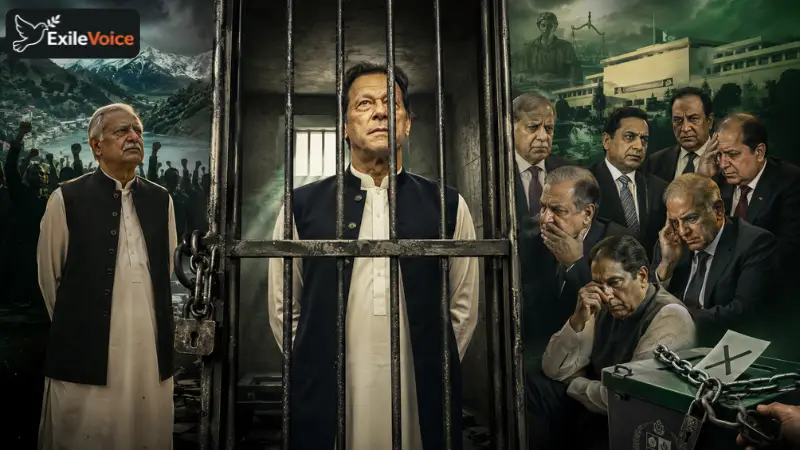
The ongoing incarceration of former Prime Minister Imran Khan, which has now crossed the threshold of a thousand days, is causing structural shifts within the fabric of Pakistani politics. For over a year, the state’s strategy appeared predicated on the assumption that prolonged isolation, legal pressure, and harsh prison conditions would erode Khan’s political resolve and dismantle the organizational structure of the Pakistan Tehreek-e-Insaf (PTI). However, recent public admissions from leading figures within the ruling coalition suggest that this calculus has missed its mark, leading to an involuntary reassessment of Khan's political survival.
In a remarkable public pivot, Federal Minister and senior Pakistan Muslim League-Nawaz (PML-N) leader Rana Sanaullah openly conceded that his initial political assessments regarding Khan’s endurance were incorrect. Sanaullah had previously built an aggressive political narrative claiming that Khan, accustomed to a life of privilege and alleged personal dependencies, would be unable to withstand the psychological and physical rigors of a high-security prison environment. The public retraction of this narrative, with Sanaullah acknowledging that Khan has endured his imprisonment effectively, signals an underlying institutional frustration. The failure of imprisonment to break Khan’s political relevance has left the ruling elite without a clear strategy for the upcoming electoral and political cycles.
Simultaneously, this prolonged detention is driving unexpected realignments among historical political adversaries. Mahmood Khan Achakzai, the chief of the Pashtunkhwa Milli Awami Party (PkMAP) and a veteran politician who spent decades opposing PTI’s populist rhetoric, has transformed into a critical ally. Achakzai has taken a firm stance against the government, issuing a formal three-day ultimatum demanding clear state policy regarding Khan’s medical treatment and institutional access. Achakzai's demands focus on two fundamental points: immediate clarity on when official meetings can take place and the right of Khan to receive medical attention at a facility of his and his family's choosing.
This alliance demonstrates the fluid nature of Pakistani politics, where yesterday's rivals routinely become today's partners. Khan’s ability to draw ideological stalwarts like Achakzai into his camp, while maintaining a strong support base from behind bars, underscores a failure of the state’s containment strategy. The heavy-handed approach used to sideline the opposition has instead united disparate political factions under a single anti-establishment banner.
Furthermore, this political friction is spreading to regional territories, including Azad Jammu and Kashmir (AJK). The recent decision by the regional election commission to deny registration to PTI for upcoming local polls has sparked widespread accusations of unconstitutional exclusion. Political analysts note that these sweeping bans across different administrative regions point to a broader, systemic campaign to entirely block the country's most popular political entity from the democratic process.
The state’s current dilemma is that its aggressive legal and administrative actions against Imran Khan have yielded diminishing returns. Rather than fading into political obscurity, Khan's prolonged detention has turned him into a central figure of resistance around whom fragmented opposition groups are actively consolidating. As historical adversaries continue to shift their positions and demand institutional accountability, the current ruling coalition faces growing isolation, forcing them to rely on administrative blockades rather than popular democratic support.