
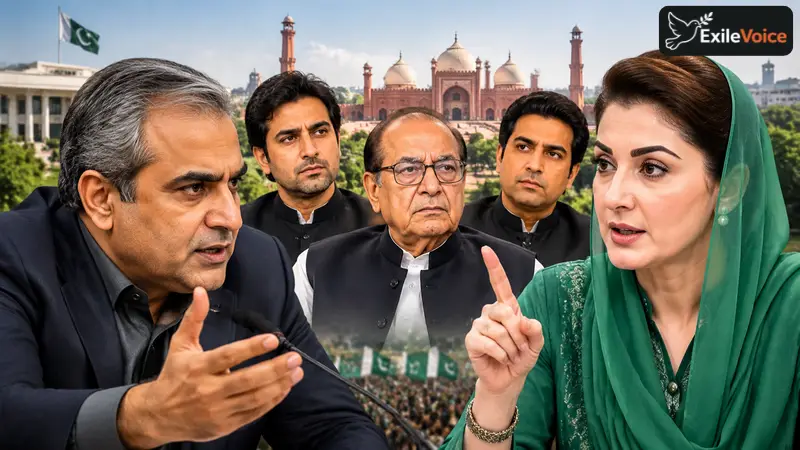
A sharp political confrontation unfolded in Lahore as Punjab Chief Minister Maryam Nawaz faced mounting pressure from multiple quarters, centered on a public clash with the sons of veteran politician Chaudhary Shujaat Hussain and a high-profile visit by Federal Interior Minister Mohsin Naqvi. What began as heated exchanges over allegations of corruption in Punjab has rapidly evolved into a broader test of political influence, administrative authority, and institutional backing inside Pakistan's most populous province.
For days prior to the latest developments, tensions had been building between Maryam Nawaz and Chaudhary Salik Hussain alongside Chaudhary Shafe Hussain. Chaudhary Salik had publicly alleged that widespread corruption was taking place inside Punjab, triggering sharp pushback from Maryam Nawaz and members of her provincial cabinet. The dispute escalated quickly from verbal sparring to formal legal notices and counter-notices, followed by reports that security arrangements had been withdrawn from Chaudhary Salik and accusations aired on live television broadcasts regarding the Chaudhary brothers.
Observers and political commentators noted a critical family connection underlying the friction: Mohsin Naqvi and Chaudhary Salik Hussain are brothers-in-law, as their wives are sisters. Because Chaudhary Salik and Chaudhary Shafe are generally known for a more measured, low-key public style rather than aggressive confrontation, many political watchers suspected that behind-the-scenes calculations and broader alignments were shaping the standoff. Even when Naqvi avoided extensive public polemics on the immediate dispute, his earlier remarks that the existing system was broken and required something new resonated alongside broader critiques of governance and corruption across the country.
On the provincial government side, Maryam Nawaz's ministers and aides sought to frame the dispute around administrative appointments, specifically pointing to disagreements over the posting of the deputy commissioner in Gujrat. Meanwhile, voices associated with the Chaudhary family raised the prospect of creating a new province that would place Gujrat in a separate administrative unit, contrasting pledges of public service with high-cost government purchases such as expensive aircraft.
Against this backdrop of open friction between Maryam Nawaz and the Chaudhary brothers, Mohsin Naqvi traveled to Lahore and visited close relatives, a trip that took on added political weight when Chaudhary Shujaat Hussain and his two sons sat with him and official statements and photographs were released. The messaging around the meeting emphasized national security, law and order, counterterrorism efforts in Balochistan and Khyber Pakhtunkhwa, decentralization of authority to lower tiers, and the broader debate over administrative units and public consultation.
Politically, the optics of sitting with Chaudhary Shujaat Hussain and presenting briefings carried clear symbolism in Lahore. In Pakistani political theater, public meetings with senior elder figures or party patrons have long been used to project authority, legitimacy, and political weight. By meeting Chaudhary Shujaat Hussain at a moment of acute tension between the Chaudhary sons and the Punjab chief minister, Naqvi signaled where his family ties and political alignment stood while underscoring his own influential position within the federal government apparatus.
At the same time, the clash in Lahore highlighted deeper vulnerabilities around governance and public spending in Punjab. Critics pointed to controversies surrounding the Suthra Punjab sanitation initiative, where operations in major divisions such as Lahore, Gujranwala, Faisalabad, and Multan were reported to be shifting from contractors back to deputy commissioners amid scrutiny over financial dues and alleged kickbacks. Business leader Mian Mansha also weighed in on the broader economic environment, calling for a smaller government footprint, lower energy costs, reduced bureaucratic hurdles, better infrastructure, and policies that encourage private investment and job creation rather than entrenched inefficiencies.
Together, these developments show that the contest in Punjab is about far more than a local dispute over administrative postings or personal grievances. It reflects competing centers of influence, contested narratives on corruption and service delivery, and a shifting balance of power in Lahore that could reshape provincial politics in the months ahead.