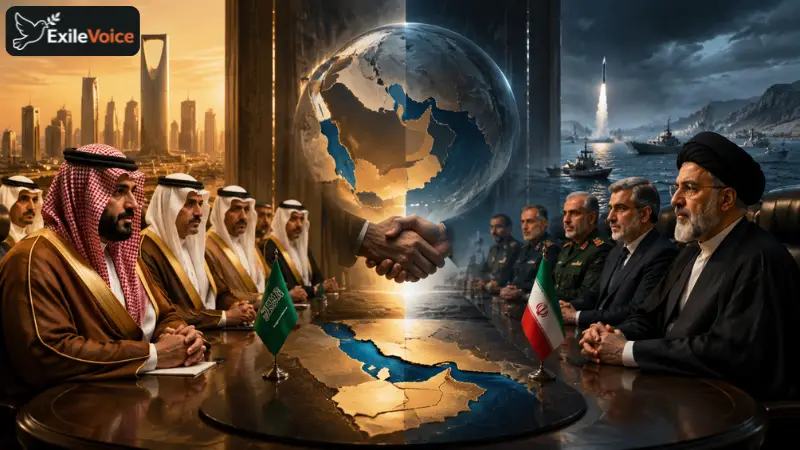
The geopolitical architecture of the Persian Gulf is undergoing a profound and systemic shift, marked by a historic diplomatic initiative spearheaded by Riyadh. According to high-level diplomatic indicators and reporting from the Financial Times, Saudi Arabia has drafted and circulated a comprehensive regional non-aggression framework to Gulf states, most notably including the Islamic Republic of Republic of Iran. This strategic document functions as a structural blueprint designed to establish regional stability through a formal commitment to mutual non-aggression and sovereign integrity. The core of the proposal mandates that signatory nations not only refrain from initiating direct military operations against one another but also explicitly deny third-party actors the use of their domestic airspace, military infrastructure, or sovereign territory to launch hostile actions against any country within the pact.
This ambitious diplomatic move is modeled deliberately after the historic Helsinki Accords of 1975, a landmark instrument signed during the peak of the Cold War to reduce tensions between the Soviet bloc and Western nations. By attempting to implement a Middle Eastern iteration of the Helsinki framework, Saudi Arabia seeks to institutionalize a permanent de-escalation mechanism in a region long plagued by proxy warfare, asymmetric conflict, and volatile security dilemmas. European powers have reportedly engaged heavily with this text through back-channel communications, offering strong diplomatic support and urging Gulf Cooperation Council (GCC) members to formally embrace the initiative to secure international maritime trade routes, particularly the crucial Strait of Hormuz.
However, the realization of this collective security architecture faces significant friction due to divergent strategic calculations among regional players. While Saudi Arabia is actively pursuing a negotiated diplomatic settlement with Tehran, a policy shift that marks a departure from its historical stance, the United Arab Emirates (UAE) is exhibiting profound hesitation. This strategic divergence is contextualized by recent, highly volatile military exchanges. Reports published by Bloomberg indicate deep structural fractures within the GCC alliance, revealing that following recent direct missile and drone strikes targeting Emirati territory, the UAE urgently appealed to its regional neighbors, including Saudi Arabia and Qatar, to form a joint military coalition to execute retaliatory actions against Iranian targets.
The unanimous refusal of these neighboring states to engage in a direct kinetic confrontation with Iran has left Abu Dhabi navigating a complex, isolated security environment. This sense of strategic abandonment has driven the UAE to accelerate alternative security arrangements outside the traditional Arab framework. A highly significant indicator of this shift was a verified, high-level intelligence meeting held in Al Ain, where Israeli Prime Minister Benjamin Netanyahu met secretly with UAE President Sheikh Mohamed bin Zayed Al Nahyan to coordinate defensive strategies. Although Emirati officials issued formal public denials to preserve diplomatic equilibrium, the official confirmation from the Israeli Prime Minister’s office underscores the emergence of an alternative, hardline axis. This evolving security dynamic splits the Gulf into two distinct schools of thought: a Saudi-led faction prioritizing a non-aggression pact to integrate Iran into a stabilized economic framework, and an Emirati-Israeli alignment focused on active military deterrence and hard security containment.