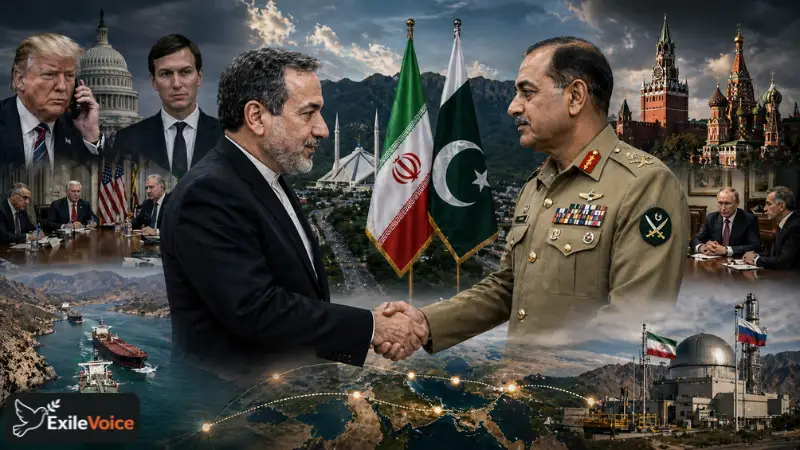
Regional diplomacy in the Middle East has entered a complex "limbo" phase, where the traditional definitions of war and peace no longer apply. This state of uncertainty is best exemplified by the sudden return of Iranian Foreign Minister Abbas Araghchi to Pakistan. His arrival signals that despite the public hardening of positions in Washington, the back-channel negotiations are not only active but are evolving into a new format of "shuttle diplomacy." Pakistan, acting as a "streaming service" for regional players, finds itself in a unique position where it hosts the dialogue but does not necessarily hold the "remote control" to dictate the outcome.
The return of Araghchi to Islamabad comes at a critical juncture. Initially, it appeared that talks had stalled after Donald Trump ordered his senior advisors, Jared Kushner and Steve Witkoff, to cancel their planned trip to Pakistan, citing a preference for remote "telephone diplomacy." However, the Iranian side appears more divided, with a internal struggle manifesting between the "hardliners," the "practicalists," and the "Revolutionary Guards." The destruction of senior leadership tiers within the Iranian establishment by external strikes has left a vacuum where "Number 4s and 5s" are now competing for influence, complicating the negotiation process.
Pakistan's value in this equation is its function as a conduit. While Oman has served as a maritime partner for Iran, notably avoiding the Iranian-led attacks that have targeted other Gulf nations, Pakistan serves as the diplomatic bridge to the West. Reports suggest that Araghchi has provided Pakistan with a "green light" to present specific Iranian terms to the Trump administration. This places General Asim Munir and the Pakistani diplomatic core in a high-stakes position. There is growing speculation that the next phase will involve high-level Pakistani representation traveling to Washington to hand-deliver these terms, especially given Trump’s recent statement that face-to-face talks with Iran are currently off the table.
The situation is further complicated by the involvement of Russia. Araghchi’s planned visit to Moscow suggests that the nuclear dimension of the standoff is being outsourced to the Kremlin, which has historically acted as a safe-keeper for Iranian nuclear material. For Pakistan, the challenge is to maintain its relevance without being caught in the crossfire of the internal divisions of its neighbors. The "Islamabad Accord" that many anticipated may not materialize as a formal summit, but rather as a series of coordinated remote agreements, an "iPhone Accord", mediated through the tireless shuttling of Pakistani and Omani officials.