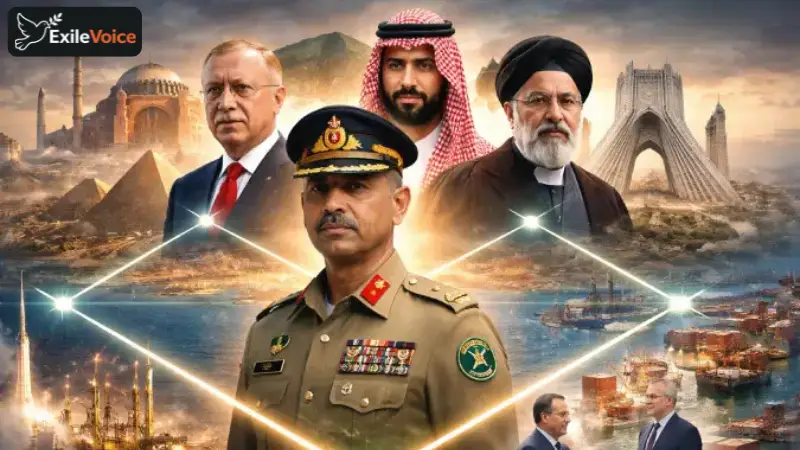
In an unprecedented display of "shuttle diplomacy," Pakistan’s top leadership has embarked on a high-stakes mission across the Middle East. General Asim Munir’s recent visit to Tehran, accompanied by a high-powered delegation, signals a significant shift in Pakistan's role from a regional spectator to a pivotal mediator. This move comes at a time when the world is closely watching the escalating tensions between Iran and Western powers, particularly regarding the blockade of the Strait of Hormuz.
The current geopolitical landscape is defined by what analysts call "Block Politics." Pakistan finds itself at the center of a diamond formation, a strategic alignment involving Turkey to the north, Egypt to the west, Saudi Arabia to the south, and Pakistan to the east. Collectively representing over 600 million people, this block holds the potential to influence global energy security and Islamic world stability. Pakistan's unique position as the only nuclear-armed Islamic nation and a key NATO ally (via Turkey) gives it a specialized leverage that few other nations possess.
Reports indicate that General Munir is not merely visiting for bilateral talks but is actively negotiating "middle ground" settlements. A primary focus is the Iranian nuclear enrichment program. While Iran proposes a five-year cessation of enrichment and the United States demands twenty, Pakistan is reportedly floating a compromise of ten to fifteen years. Success in these negotiations would not only stabilize the region but also cement Pakistan’s status as a global diplomatic heavyweight.
Simultaneously, Finance Minister Muhammad Aurangzeb’s engagement with U.S. Secretary of Commerce Howard Lutnick in Washington underscores the economic dimension of this pivot. By leveraging its geopolitical utility, Pakistan aims to transition from a cycle of debt and IMF reliance toward industrial and commercial growth. The opening of new trade corridors through Balochistan into Central Asia further illustrates this vision of regional connectivity.