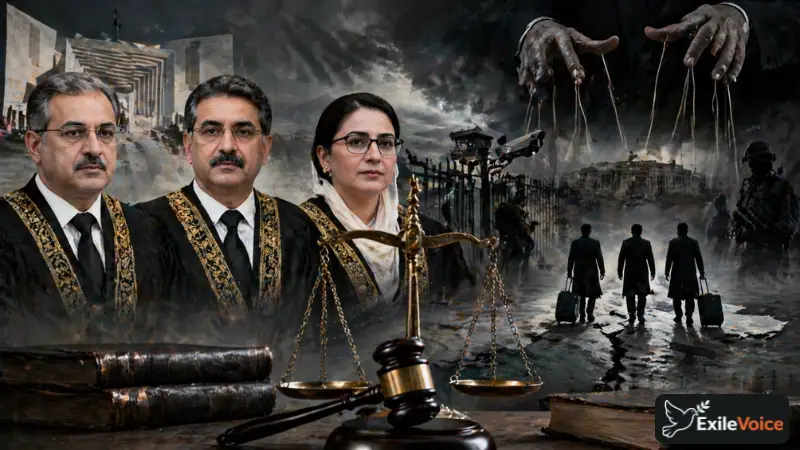
Pakistan’s legal landscape is undergoing a radical transformation that many observers characterize as the dismantling of judicial independence. The Judicial Commission of Pakistan, headed by Chief Justice Yahya Afridi, has formally approved the transfer of three prominent Islamabad High Court (IHC) judges to different provinces without their consent. Justice Mohsin Akhtar Kayani has been moved to Lahore, Justice Babar Sattar to Peshawar, and Justice Saman Rafat Imtiaz to Sindh.
These transfers were made possible by a recent amendment to Article 200 of the Constitution, which stripped judges of the right to refuse such relocations. Previously, the consent of a judge was a fundamental safeguard ensuring that the executive could not use transfers as a tool of punishment or harassment. The timing and targets of these moves are particularly telling. The three judges were among the six IHC jurists who authored a startling letter in March 2024, accusing the country’s intelligence apparatus of systematic interference in judicial affairs, including the surveillance of judges’ homes and the abduction of their relatives.
By relocating these specific judges, the state is effectively neutralizing a pocket of resistance within the capital’s judiciary. This maneuver is seen as part of a broader shift toward a "garrison state" model, where the plurality of institutions that once defined Pakistan, the courts, the media, and independent bar associations, are being consolidated under a centralized authority.
The long-term risk of this strategy is the total breakdown of the constitutional framework. Historically, even under military rule, there was a semblance of institutional balance or at least the hope of a return to democratic norms. However, the current trajectory suggests a permanent shift toward a model resembling a one-party or authoritarian state. As the judiciary loses its role as a neutral arbiter, the burden of governance falls increasingly on the security establishment, creating a fragile system that may lack the flexibility to survive future political or economic shocks.