The shifting sands of Middle Eastern diplomacy have recently placed an unexpected player at the center of the chessboard: Pakistan. As the confrontation between Iran and the United States teeters between escalation and a fragile peace, the role of the "middleman" has never been more critical. Wajahat S. Khan’s analysis suggests that Pakistan’s military leadership, specifically Chief of Army Staff General Asim Munir, has strategically positioned the country as a vital diplomatic bridge, outmaneuvering other regional leaders in the process.
The "second round" of negotiations is currently the focal point of international observation. While global powers like China and the United States hold the ultimate leverage, the logistical and diplomatic "stage management" provided by Islamabad cannot be overlooked. The recent deployments of 13,000 troops and 18 fighter jets by Pakistan serve as a dual signal: a commitment to regional stability and a demonstration of military readiness should mediation fail. However, the current strategy is one of "Producer" rather than "Actor." Pakistan is managing the backstage, ensuring that envoys from Washington, Tehran, and Riyadh have a neutral ground to de-escalate.
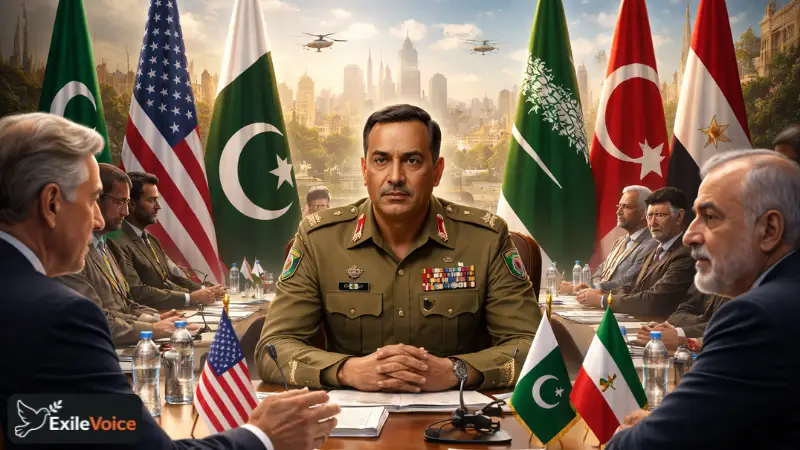
A significant development is the emergence of a new diplomatic bloc, often referred to in these circles as a "Group of Four" (G4), comprising Pakistan, Turkey, Egypt, and Saudi Arabia. This alignment represents a formidable coalition of Muslim-majority nations with significant military and economic weight. The involvement of these nations suggests that any long-term resolution to the Iran crisis will require a multilateral guarantee rather than a bilateral agreement between Washington and Tehran.
The "Asim Munir factor" remains a subject of intense debate. While domestic critics point to ongoing internal political strife and human rights concerns within Pakistan, on the international stage, Munir is being recognized by figures like Donald Trump and J.D. Vance as a reliable interlocutor. The challenge for Pakistan now is to deliver a "Middle Ground" deal. Iran is reportedly seeking a five-year commitment regarding its nuclear program, while the U.S. is pushing for a twenty-year horizon. The ability of Pakistani diplomacy to bridge this fifteen-year gap will determine if the country can move from a tactical mediator to a strategic global player.