

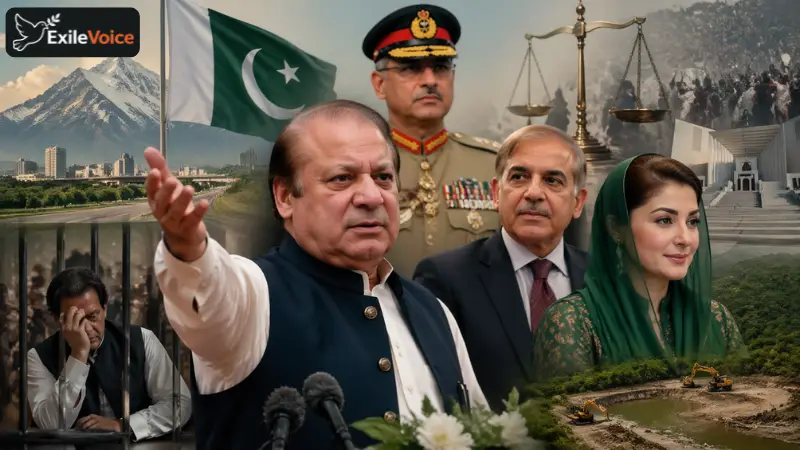
After a significant period of relative public absence, former Prime Minister Nawaz Sharif has returned to the political limelight, delivering a series of high-stakes addresses in Islamabad. Ostensibly centered around the upcoming Gilgit-Baltistan and Kashmir elections, Sharif’s discourse served a dual purpose: reinforcing the leadership of Maryam Nawaz and Shahbaz Sharif while offering a glowing endorsement of the "historic role" played by the current military leadership, specifically referring to the "Field Marshal" (General Asim Munir).
Sharif’s rhetoric focused heavily on the restoration of Pakistan’s international prestige, claiming that under the current administration’s guidance and military cooperation, the "green passport" is regaining the respect it once held in the late 1990s. However, this comeback is not without its controversies. Sharif took direct aim at provincial governments, particularly in Khyber Pakhtunkhwa (KP), where he questioned the 15-year tenure of the Pakistan Tehreek-e-Insaaf (PTI). He challenged the efficacy of their transport and healthcare systems, contrasting them with the development projects in Punjab and at the federal level.
This political posturing comes at a time of heightened tension within the judiciary and opposition. While Sharif praises the current "Form 47" governance model, opposition figures like Maulana Fazlur Rehman have begun calling for the release of Imran Khan, suggesting he be allowed to play his role in politics. This shift by Rehman is viewed by analysts as a strategic move to maintain his voter base in KP, where pro-Khan sentiment remains high, rather than a genuine break from the establishment.
Simultaneously, the domestic landscape is marred by reports of judicial pressure. Allegations have surfaced regarding the potential transfer of Islamabad High Court judges, those who previously blew the whistle on intelligence agency interference, to remote benches in Sindh or Balochistan. Such moves are interpreted by legal observers as an attempt to "corner" independent voices within the judiciary. Meanwhile, the government’s announcement of a "new park" in the Margalla Hills has drawn skepticism, with critics suggesting the project is a facade for commercial land development (DHA/Bahria style) that could devastate Islamabad’s ecological "lungs."
As the Sharif family consolidates its narrative of progress and stability, the underlying friction between the judiciary, the military-backed government, and the sidelined opposition continues to define the Pakistani political struggle.

