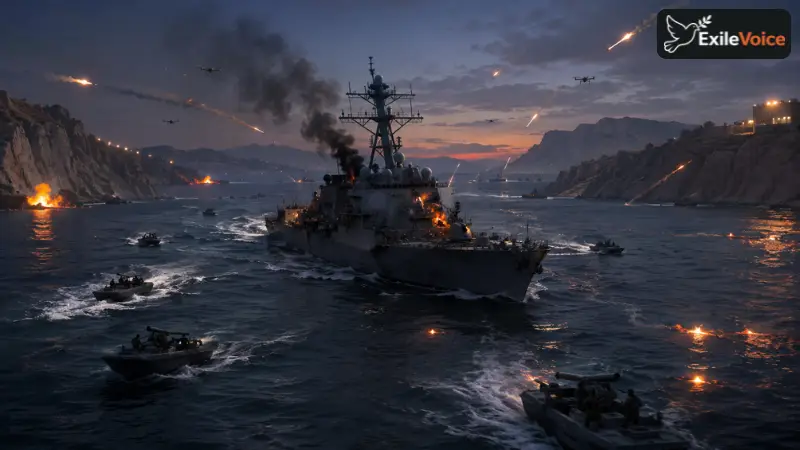
The Strait of Hormuz remains the world's most volatile maritime chokepoint, but recent events suggest a significant change in the effectiveness of traditional naval power projection. Reports from the Persian Gulf indicate that despite the overwhelming technological superiority of the United States Navy, Iranian forces have successfully utilized asymmetric warfare tactics to challenge American presence and disrupt planned operations.
Independent satellite data, including thermal detection systems from NASA’s FIRMS, has provided startling evidence that contradicts official narratives of a "seamless" maritime environment. Recent thermal imaging shows drifting fire patterns in the Strait of Hormuz, consistent with a vessel taking hits and moving under distress. This data lends credence to claims that Iranian naval forces, using a combination of drones, missiles, and fast-attack craft, have successfully repelled or damaged high-value naval assets, including U.S. destroyers.
The implications of this stalemate are far-reaching. For decades, the global order has rested on the assumption that the U.S. could unilaterally guarantee freedom of navigation through military force. However, the current "uneasy peace" suggests that the cost of such operations has risen exponentially. China, observing from the sidelines, has noted that a "second-tier" power like Iran, despite decades of sanctions, has managed to tie down a significant portion of the U.S. military’s attention and resources for over 40 days without succumbing to pressure.
This situation has created a "leverage gap" for the United States. As President Trump prepares for high-stakes negotiations with Chinese President Xi Jinping, the inability to decisively secure the Strait of Hormuz weakens his bargaining position. The perception of a "weakened giant" is growing, as reports leak from Washington suggesting that the U.S. has exhausted nearly half of its planned ten-year supply of certain precision munitions, such as Tomahawk missiles, in these recent skirmishes. The conflict in the Strait of Hormuz is no longer just a regional dispute; it is a test of the limits of modern superpower influence in an age of asymmetric resistance.