

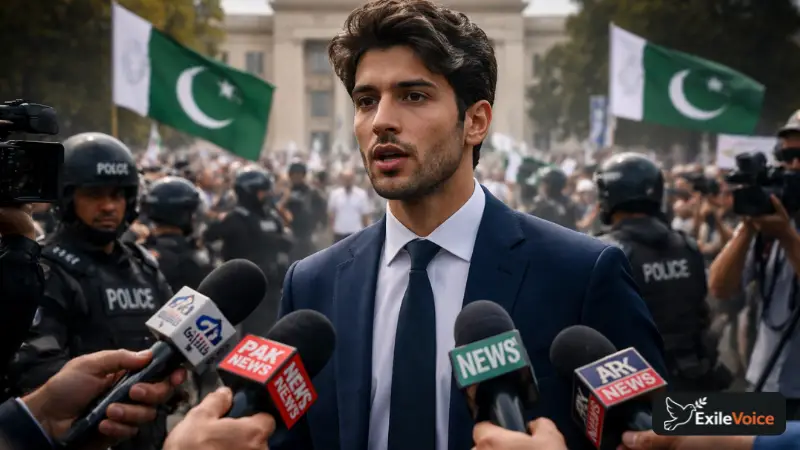
The Pakistani political landscape has witnessed a sharp escalation in tension following a brief but impactful speech by Kasim Khan, the son of former Prime Minister Imran Khan, at the United Nations Human Rights Council in Geneva. Lasting only one minute and seven seconds, the address focused on the deteriorating human rights conditions in Pakistan, urging the international community to hold the state accountable to the conventions it has signed. However, the reaction from the Pakistani establishment and its civilian allies has been swift and severe, transforming a human rights plea into a battleground of disinformation.
Government representatives and supportive media outlets have launched a coordinated campaign against the younger Khan, labeling him as "anti-Pakistan" and accusing him of lobbying for international sanctions. Specifically, high-ranking officials within the Ministry of Information and provincial leadership in Punjab have alleged that Kasim Khan demanded the suspension of Pakistan’s GSP Plus trade status. This status is vital for Pakistan’s economy, providing preferential access to European markets. Despite these loud accusations, independent fact-checkers, including prominent outlets like Dawn, have verified that no such demand for GSP Plus suspension was made in the speech.
The intensity of this targeting suggests a deeper anxiety within the establishment. Kasim Khan has emerged as an articulate, well-spoken, and presentable figure on the international stage, drawing comparisons to a young Benazir Bhutto during her early years of advocacy for her father, Zulfikar Ali Bhutto. Unlike typical "nepo babies" in Pakistani politics who are groomed for power, Kasim maintains an apolitical stance, focusing his efforts solely on the legal and human rights plight of his father and the general citizenry. His ability to hit "home runs" in interviews with international media like Piers Morgan and Mehdi Hasan has made him a perceived threat to the narrative control exercised by the current regime.
Furthermore, the establishment's attempt to link Kasim Khan and his associates, such as Zulfi Bukhari, to anti-state actors like Arif Ajakia highlights a strategy of "guilt by association." While photos and brief interactions at international conventions are common for public figures, the state has utilized these moments to construct a narrative of conspiracy. As the legal battle shifts toward the United Kingdom, where Zulfi Bukhari has announced plans to sue media outlets for defamation, the focus remains on whether the Pakistani state can sustain its domestic narrative against a more polished and credible international advocacy effort led by the next generation of the Khan family.

