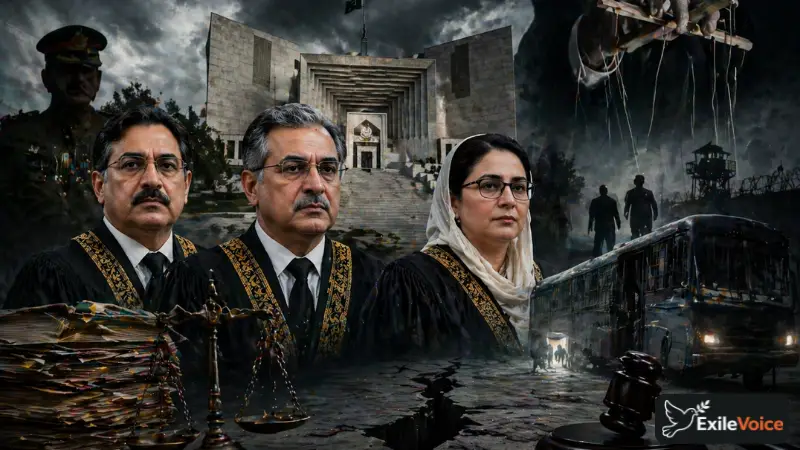
The landscape of Pakistan's judiciary has recently been shaken by a series of high-profile transfers involving some of the most independent voices within the Islamabad High Court (IHC). These moves, involving Justice Babar Sattar, Justice Mohsin Akhtar Kayani, and Justice Saman Rafat Imtiaz, have raised alarm bells regarding the sanctity of judicial independence and the potential for executive overreach. The timing and nature of these transfers suggest a systematic effort to silence or displace judges who have shown resilience against external pressures, particularly from state institutions.
The core of the issue lies in the vital role these judges have played in upholding the rule of law. Justice Babar Sattar, known for his rigorous intellectual background and critical analysis, has been moved to Peshawar. Similarly, Justice Mohsin Akhtar Kayani, who was next in line to become the Chief Justice of the IHC, has been transferred to Lahore, while Justice Saman Rafat Imtiaz has been relocated to Sindh. These are not merely administrative rotations; they represent the displacement of the very individuals who recently blew the whistle on institutional interference within the judiciary.
Earlier this year, these judges were among the six who authored a historic letter to the Supreme Judicial Council, detailing harrowing accounts of intimidation. The letter described instances of surveillance, including cameras found in the private residences of judges, and even the abduction and physical torture of their family members to extract favorable rulings. By transferring these whistleblowers, the state risks sending a chilling message: those who demand transparency and resist coercion will face professional exile.
Judicial independence is predicated on the "Dichotomy of Power," where the court serves as the ultimate arbiter between the state and the citizen. When judges fear that a ruling against the government or security apparatus will lead to their immediate transfer to remote locations or the targeting of their families, the foundation of justice collapses. A judge who is "managed" is no longer a judge but a subordinate official. This erosion of the IHC's autonomy suggests a transition toward a system where legal outcomes are predetermined by political or military necessity rather than the constitution.
Furthermore, the process through which these transfers were approved has come under scrutiny. The Judicial Commission's vote, which saw support from various high-ranking legal officials, highlights a deepening rift within the legal fraternity. Critics argue that those who facilitated these transfers have prioritized institutional compliance over constitutional integrity. For a nation already grappling with political volatility and a "Form 47" legitimacy crisis, the weakening of the one institution capable of providing neutral arbitration, the judiciary, threatens to push Pakistan toward an irreversible rule-of-law deficit.