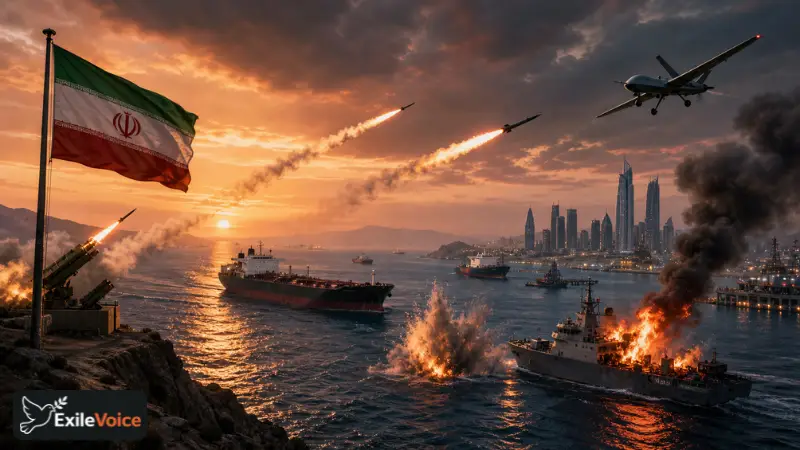
The geopolitical landscape of the Middle East has taken a volatile turn as fresh reports indicate a direct military confrontation between Iran and the United Arab Emirates (UAE). This escalation centers around the critical maritime artery of the Strait of Hormuz, a chokepoint through which a significant portion of the world's oil supply traverses.
Initial reports suggested an Iranian missile strike on a U.S. naval vessel, a claim that momentarily sent global oil prices surging toward the $113 per barrel mark. While the United States subsequently denied any direct hit on its assets, the tension did not subside. Instead, the focus shifted to the UAE, which confirmed that four Iranian missiles were fired at its maritime territory. Viral footage, though its absolute authenticity remains under debate, appeared to show a UAE vessel engulfed in flames following a missile strike. UAE authorities further corroborated the aggression by announcing the interception of three additional Iranian missiles, while a drone attack on the Port of Fujairah resulted in injuries to three Indian nationals.
These events have triggered a "tug-of-war" in the global energy markets. Oil prices spiked by as much as $15 per barrel in a single day of trading, reflecting the market's acute sensitivity to disruptions in the Persian Gulf. For the United States, this creates a complex domestic challenge. With gasoline prices approaching $4.50 per gallon in several states, the pressure on the Trump administration is mounting. President Trump, viewing the conflict through a business lens, faces the difficult task of balancing military deterrence with the need to prevent a full-scale energy crisis that could derail domestic economic stability and increase the cost of living for American consumers.
Strategically, this conflict highlights a deepening "strategic alliance" between Israel and the UAE. Former Israeli Prime Minister Naftali Bennett characterized the attack on the UAE as a "declaration of war" by Iran, affirming that Israel stands firmly with its strategic partner. This alignment is further evidenced by reports of Israel transferring advanced laser-based drone defense technology to the UAE. As the region reshapes itself, the restraint shown toward Saudi Arabia and Qatar by Iran suggests a calculated attempt to isolate specific rivals while testing the resolve of the new Abraham Accords-based security architecture.