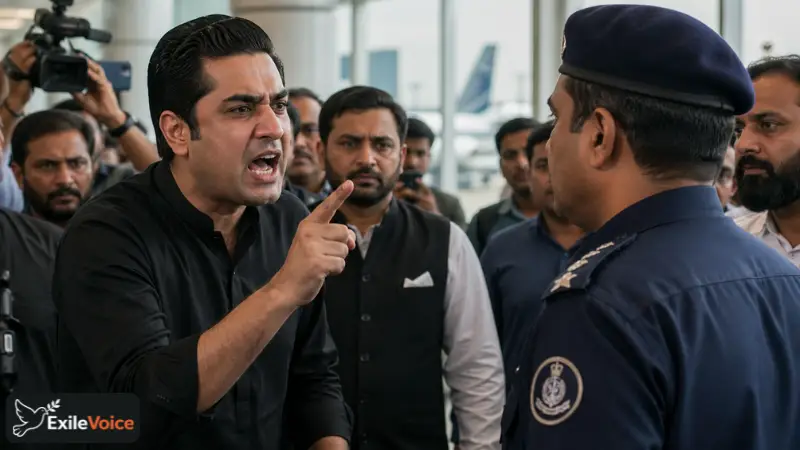
The recent altercation at Lahore’s Allama Iqbal International Airport involving prominent television personality and budding politician Iqrar Ul Hassan has sparked a national debate regarding the conduct of public figures and the limits of state authority. The incident, which was captured in a now-viral video, shows Hassan in a heated exchange with an official from the Federal Investigation Agency (FIA). While the immediate cause of the friction appears to be a personal remark allegedly made by the officer, the underlying dynamics suggest a much deeper crisis in Pakistan’s socio-political fabric.
At the heart of the confrontation is the transition of media personalities into the political arena. Iqrar Ul Hassan, known for his investigative program "Sar-e-Aam," has built a career on confronting corruption and social ills, often using aggressive and theatrical methods. However, as he ventures into formal politics with his "Awam Raj" party, his interactions with state institutions are being viewed through a different lens. The airport incident highlights the tension that arises when a person accustomed to the "vigilante" style of journalism enters a space where protocol and state hierarchy are paramount.
The video reveals a significant level of aggression. Hassan is heard demanding "manliness" and "courage" from the officer, accusing him of making political comments while in uniform. This raises critical questions about the professional ethics of both parties. While a government official in uniform is expected to maintain neutrality and refrain from passing judgment on citizens, the reaction from the public figure, characterized by shouting and public shaming—points toward a culture of entitlement that often plagues Pakistan’s elite and influential classes.
Furthermore, this incident serves as a case study for the "Project Politics" theory often discussed in Pakistani political circles. Critics argue that certain media figures are "launched" by powerful circles to serve specific narratives. When these figures clash with the lower-tier bureaucracy, it exposes the disconnect between the high-level backing they might enjoy and the ground reality of state operations. The officer involved, likely a lower-grade employee, represents a segment of the workforce that often becomes a punching bag for those seeking to project power.
Professionalism in public spaces is a two-way street. For Pakistan to move toward a more stable governance model, both state officials and influential media-turned-political leaders must adhere to a code of conduct that prioritizes de-escalation over confrontation. Using "manliness" or "bravery" as a metric for political discourse only serves to further polarize a society already struggling with volatility.