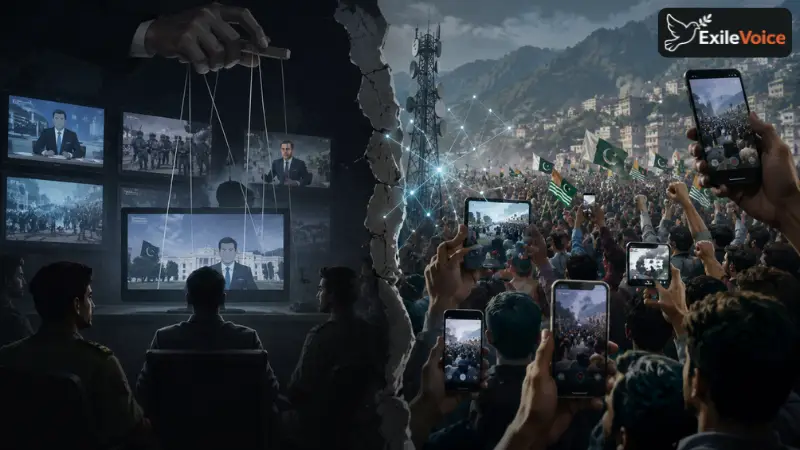
The management of information during the 2026 crises in Pakistan offers a revealing case study in how state institutions use narrative control to shape political outcomes. As civil unrest escalated across Azad Jammu and Kashmir, federal regulatory and security apparatuses implemented a strict media blackout across all mainstream television networks. This calculated suppression of live reporting highlights an ongoing reliance on traditional information-control strategies. However, in an era dominated by decentralized digital platforms, these methods face structural limitations that often undermine state credibility.
For days surrounding the deployment of security forces in the region, the country's legacy media maintained total silence on the expanding public protests and subsequent security operations. This information vacuum was not accidental; it was the result of direct administrative orders issued to broadcasting executives prior to the security crackdowns. By preventing mainstream television from airing footage of public dissent or civilian casualties, state planners hoped to contain the political fallout and prevent solidarity protests in other urban centers like Islamabad or Lahore. When traditional media blackouts created an information vacuum, state entities shifted to a proactive propaganda strategy, using legacy networks to broadcast selectively released content designed to undermine the protest movement. This approach used three main narrative lines:
First, public dissociation was emphasized. Mainstream networks gave significant airtime to statements from figures like Faisal Gillani, a purported member of the action committee, who publicly distanced himself from the protests and accused leadership of incitement. By broadcasting these statements on screens that had completely ignored the ongoing strikes, the state attempted to portray the action committee as fractured and lacking internal legitimacy.
Second, the state relied heavily on extranational accusations. Intelligence and security agencies announced the arrest of individuals in Muzaffarabad allegedly linked to India’s Research and Analysis Wing (RAW). This announcement was paired with media reports claiming that security raids on the residences of protest leaders, such as Bookseller Association leader Shaukat Nawaz Mir, uncovered foreign currency and illicit weapons. Linking domestic dissidents to foreign intelligence operations is a long-standing practice aimed at shifting public focus from valid economic complaints to urgent national security concerns.
Third, security-risk labeling was expanded to new regions. In their broadcasts, state-aligned media outlets increasingly used security-risk terminology, traditionally reserved for militant factions along the western border, to describe the Kashmiri action committees. Labeling domestic civic groups with security-risk terminology allows the state to justify using counter-terrorism tactics against civilian populations.
Despite these extensive efforts, the state's narrative strategy faces major structural challenges in the modern information landscape. The absolute silence of legacy media on major regional events has accelerated a loss of public trust in domestic television networks. Audiences have increasingly turned to digital platforms, localized VPN networks, and international reporting streams to access real-time information.
As a result, state-directed programming on legacy networks often ends up preaching only to the converted, while the wider public dismisses it as institutional propaganda. This growing divide between official state narratives and digital reality weakens the state's domestic communication strategies, making it harder to build a genuine national consensus during times of crisis.