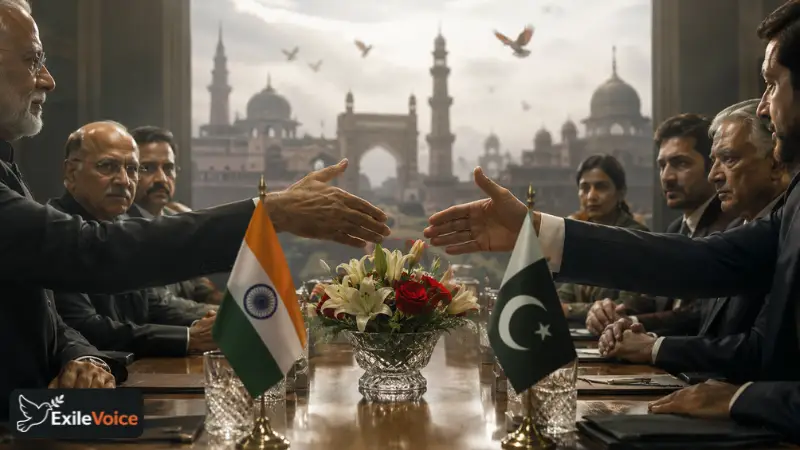
The geopolitical landscape of South Asia is undergoing a quiet, structural realignment that challenges standard analytical frameworks. In an unprecedented institutional maneuver, the Rashtriya Swayamsevak Sangh (RSS), traditionally characterized as the uncompromising ideological bedrock of Hindu nationalism and the paternal foundation of India's ruling Bharatiya Janata Party (BJP), has extended a calculated diplomatic olive branch toward Pakistan.
In a recent comprehensive briefing, RSS General Secretary Dattatreya Hosabale, who commands significant authority as second-in-command under Mohan Bhagwat, asserted that New Delhi must maintain an open, resilient window for dialogue with Islamabad. While maintaining that the state must fiercely counter cross-border security challenges, Hosabale emphasized that cultural exchange and people-to-people initiatives should serve as permanent fixtures of regional statecraft. This marks a profound departure from the rigid rhetoric that defined regional relations following the intense military and diplomatic standoffs of 2025.
This development is not a random rhetorical shift; rather, it represents a highly synchronized effort to provide political insulation for Prime Minister Narendra Modi's administration. As detailed in an authoritative analysis by The Hindu, an ideological declaration of this magnitude from the parent organization offers the executive branch indispensable political cover. Historically, any attempt by a BJP administration to soften its posture toward Pakistan invited severe domestic blowback from its core electoral base. By initiating this discourse directly from the ideological core of the movement, the RSS effectively neutralizes right-wing opposition, granting Modi the tactical flexibility to engage in backchannel diplomacy without risking domestic political capital. This assessment gained rapid institutional weight when retired General Manoj Naravane, the former Chief of Army Staff, publicly endorsed the RSS statement, characterizing it as a sophisticated, timely, and strategically vital paradigm shift for bilateral relations.
The institutional echoes of this maneuver have reverberated across the security apparatus and regional governance bodies. Within hours of the declaration, senior Kashmiri political figures, including National Conference President Farooq Abdullah and People’s Democratic Party leader Mehbooba Mufti, issued formal statements welcoming the development. Analysts familiar with the region note that these leaders rarely align with the political agendas of either the BJP or the Congress party; instead, their public stances reflect deep-seated coordination with India’s primary internal intelligence and external security frameworks, including the Intelligence Bureau (IB) and the Research and Analysis Wing (RAW). Their synchronized endorsement strongly indicates that a comprehensive, structured blueprint for a diplomatic off-ramp has already passed through rigorous institutional vetting behind closed doors.
This diplomatic recalibration must be understood within its global context, specifically regarding the overt geopolitical leverage exerted by the Donald Trump administration. Washington has demonstrated a clear intent to stabilize the South Asian theater, utilizing its substantial goodwill with both the Indian executive branch and Pakistan’s military leadership. By leveraging these deep institutional ties, American intermediaries have quietly nudged both capitals toward a sustainable backchannel framework. Consequently, Pakistan's Foreign Office issued a rapid, measured response welcoming the return of diplomatic sanity to the region. This swift de-escalation underscores a shared realization that the escalatory cycles of previous years have yielded diminishing returns for both nuclear-armed states, paving the way for a pragmatic, interest-driven detente.