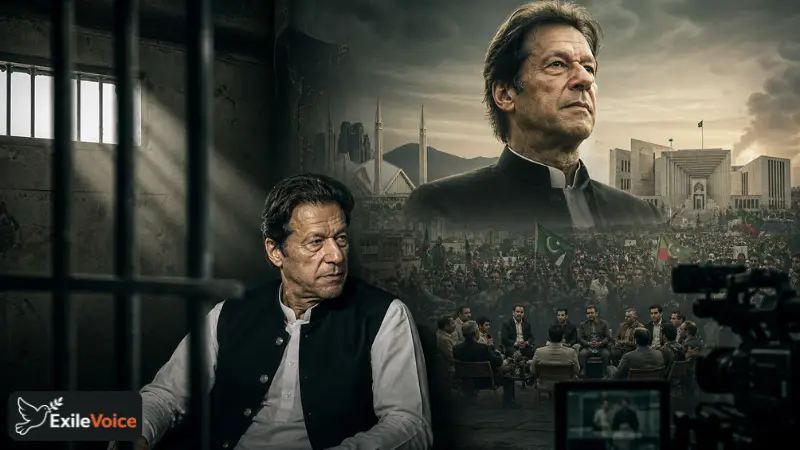
Even as the Pakistani political landscape undergoes rapid shifts, the figure of Imran Khan continues to dominate the national discourse with an unprecedented level of resilience. Despite surpassing 1,000 days in detention, Khan’s influence remains the central axis around which Pakistani politics rotates. This phenomenon is particularly striking given his near-total removal from the physical public sphere. Whether in drawing rooms, dinner table conversations, or international think-tank reports, the narrative surrounding the former Prime Minister is more potent today than it was during his time in office.
Journalist Wajahat S. Khan notes that this "Khan phenomenon" has effectively paralyzed the current establishment's attempts to move on. There is a psychological paradox at play where the more the state attempts to suppress his image or voice, the more he dominates the "National Conversation." Even in Washington, D.C., policy circles and think tanks are increasingly debating the credibility of Pakistan’s current leadership in comparison to Khan. Recent columns and reports suggest that if Khan were at the helm, Pakistan might have possessed the "gravitas" and "strength" required to adjudicate regional conflicts, specifically between Iran and Western powers, rather than merely acting as a passive mediator.
The persistence of his name is not just limited to political debates but extends to real estate and legal dramas. For instance, the recent raids on luxury apartments at One Constitution Avenue immediately triggered public association with Khan, despite numerous other elites residing there. This indicates that for a significant portion of the population and the international community, Pakistan’s identity and its future trajectory are inextricably linked to the resolution of Khan's legal and political status. The establishment's strategy of "less is more", assuming that reducing his visibility would diminish his relevance, has backfired, creating a vacuum that his supporters fill with a near-mythological narrative of resistance.